Blog
Singing Dunes in Kazakhstan: Complete Guide from Almaty — How to Get There, When to Go, and What to Bring
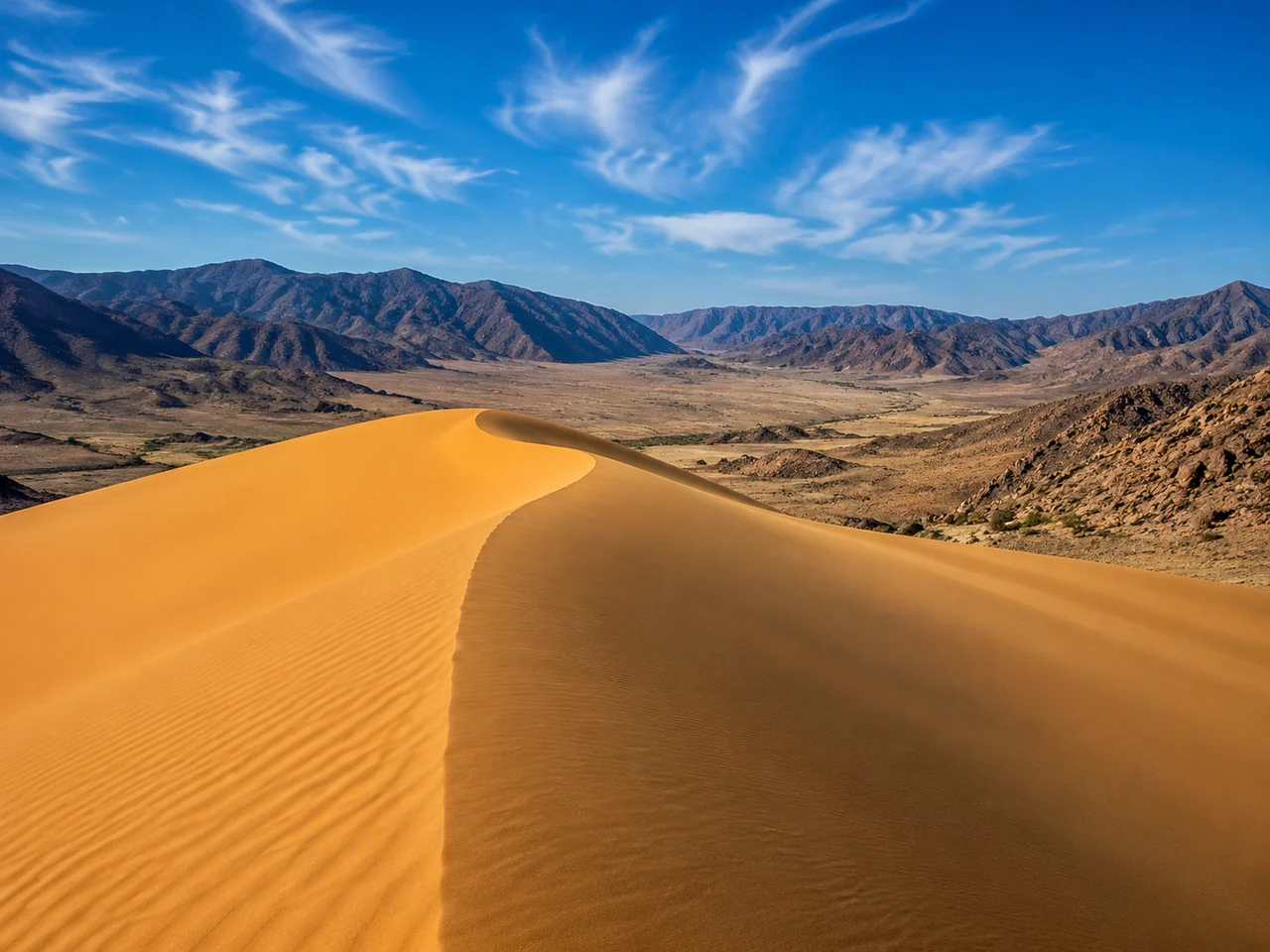
The Singing Dune is a unique natural site in the Altyn-Emel National Park, 200 km from Almaty. At toor, we organize one-day tours with transfer, guide, and lunch from 18,000 tenge per person. We explain how to plan your trip independently or with a tour to hear the famous dune singing.
What is the Singing Dune and why does it sing
The Singing Dune (Akkum) is not just a sand mountain, but a unique natural resonator: a dry dune as tall as a 50-story building emits a low-frequency hum of up to 100 dB when sand moves. We explore where this wonder is located, why it produces sound, and at what time it can be heard for sure.
What is the Singing Dune and where is it located
The Singing Dune (Akkum) is a sand dune 150 meters high, 3 km long, and 1 km wide in the Altyn-Emel National Park, 250 km northeast of Almaty. Unlike desert dunes, Akkum stands alone on a plain at the foot of the Malaisary ridge — its sand has accumulated here over millennia due to winds blowing from the Dzungarian Gate. The dune has a steep southern slope (up to 45 degrees) and a gentle northern one, creating ideal conditions for "singing": when descending the steep side, sand grains avalanche and rub against each other. It is one of the largest dunes in Central Asia, and its size constantly changes due to wind — the dune "breathes" and shifts several meters per year, so park maps are regularly updated.
Why the dune produces sound — scientific explanation
The sound arises from the friction of dry quartz sand grains of different sizes during movement — creating a low-frequency hum of up to 100 dB, similar to the hum of a turbine or a jet engine. The mechanism is as follows: when sand slides down the slope, larger particles (0.2–0.5 mm) rub against smaller ones (0.05–0.1 mm), and the friction generates synchronous vibrations — resonance, amplified by the dune's shape acting as a natural horn. Scientists from the Kazakh National University found that the sound frequency depends on the descent speed: the faster the avalanche, the lower the tone. To hear the hum, the sand must be absolutely dry — after rain or in winter, the dune is "silent" because moisture glues the sand grains together and dampens the resonance, turning the dune into an ordinary hill.
When and how is the dune singing best heard
The hum is best heard in dry, windless weather when descending from the top of the dune — it is the movement that creates the sand avalanche and triggers the resonance. The sound is most distinctly perceived if you descend not along a beaten path, but along a fresh, untouched slope: new sand is not compacted, and friction is maximized. In the morning and evening, the sound is heard more clearly because there is no wind or background noise — at noon, due to heat and wind, the hum may be quieter or absent altogether. Wind over 5 m/s breaks the avalanche into small portions, and instead of a hum, only a rustle is heard — check the Windy forecast before departure.
Where is the Singing Dune located: distance from Almaty and coordinates
The Akkum dune stands 200 km northeast of Almaty, within the Altyn-Emel National Park, and you can get there in half a daylight day.
Distance and travel time
From the city to the Singing Dune is about 200 km, travel time by car is 3–3.5 hours depending on road conditions and the state of the dirt road. The first 180 km are asphalt along the A-3 highway through the village of Shelek, where speed is maintained at 80–90 km/h. The last 20 km is a dirt road through the national park territory, taking 30–40 minutes even in a prepared SUV: sand and clay after rains turn into mud, and in dry weather raise dust, reducing visibility to 15–20 meters. In the dry season (May–September), a regular sedan with high ground clearance can pass, but in the off-season, it is better to plan the trip with a four-wheel-drive vehicle — a tow truck from the park will cost 50–70 thousand tenge and take 4–5 hours of waiting.
Coordinates and landmarks
The dune is located within the Altyn-Emel National Park, the nearest settlement is the village of Basshi (about 30 km from the dune). The coordinates of the park entrance (Altyn-Emel checkpoint) are N 43.8594, E 78.6627; from there, it is another 10 km along a dirt road with signs. A landmark on the A-3 highway is the turn after the village of Shelek (approximately 150 km from Almaty), where there is a blue sign "Altyn-Emel National Park 25 km" — do not miss it, the next exit will be in 40 km. Inside the park, mobile reception is only available at the checkpoint and on the dune's summit (Beeline and Tele2 work unstably, Kcell — slightly more reliably), so download an offline map of Altyn-Emel in 2GIS or Maps.me before departure — GPS without internet shows the road steadily.
How to get from Almaty: by car, taxi, or with a tour
We break down three ways to get to the dune: by personal car, by taxi, or as part of an organized tour. We compare by price, convenience, and travel time.
By personal car — vehicle requirements and roads
You can only reach the dune with an SUV or a car with high ground clearance — a regular passenger car risks getting stuck on the 20-kilometer dirt road. The A-3 highway to the turn for Altyn-Emel is paved and takes 2.5 hours, but the last stretch to Akkum is sand, clay, and stones: in a sedan with low clearance, you will bottom out or puncture the oil pan. Four-wheel-drive Toyota Land Cruiser Prado or Mitsubishi Pajero handle confidently, while a front-wheel-drive Nissan Qashqai with road tires is a gamble: in dry weather you will pass, in wet weather you will be pushing. There are no gas stations or tire repair shops in the national park; the nearest gas station is in the village of Basshi, 30 km away, so a fuel reserve and a spare tire are mandatory. Even in a four-wheel-drive vehicle, check the road before departure: after rains, the dirt road becomes muddy, and you can only pass with a prepared SUV.
Taxi from Almaty — price and features
A taxi from Almaty to the dune costs from 25,000 KZT one way, but the driver may refuse to drive on the dirt road without an extra fee. On aggregators like Yandex.Taxi, the price is set up to the turnoff to Altyn-Emel — then bargaining begins: for 20 km of sand, they ask for another 5,000–10,000 KZT on top, and not everyone agrees even for that money. Finding a return car at the dune is almost impossible — there's no signal, the nearest settlement, Basshi, is a half-hour drive away, and drivers don't go there without a pre-order. That totals 50,000+ KZT just for transport, not including entrance tickets and food, and the taxi driver will have to wait for you all day or come back — both options are inconvenient.
Tour with toor.kz — what's included and how much it costs
A tour with toor.kz costs from 18,000 KZT per person and includes transfer by SUV, entrance tickets to Altyn-Emel, lunch, and guide services. Departure at 7 a.m. allows you to arrive at the dune before the midday heat, when the sand heats up to +40°C and the wind raises dust. Groups of up to 8 people, the vehicle is a Toyota Land Cruiser 100 with air conditioning and a driver who knows every turn of the dirt road. Lunch — hot food in the field (pilaf or soup), water and tea are included, you don't need to bring anything. Unlike a self-guided trip, here you don't have to worry about the dirt road, navigation, or lunch — everything is organized, including insurance and a first aid kit.
Best time to visit: seasons and weather by month
We break down the weather by month so you can choose the ideal time — when the dune sings and the temperature allows comfortable time in the open sun.
Season for visiting: April–October
The season for visiting the Singing Dune is from April to October, when the sand is dry and the dune actively hums, and the temperature allows you to be in the sun without risk of overheating or hypothermia. In April, the air warms up to +10..+15°C during the day, and in October it stays around the same values — this is the lower comfort limit, but the dune already "sounds" in dry weather. In May and September, the average daily temperature rises to +20..+25°C, which is ideal for long stays in open spaces. From June to August, the thermometer regularly exceeds +30°C, and at the peak in July reaches +40°C, requiring strict planning of your visit time for morning or evening. In April and October, the weather can be changeable — +10..+15°C during the day, but the wind makes the temperature feel significantly lower, so a windbreaker is necessary even in the "warm" months.
Best months: May and September
The ideal months for a trip are May and September, when the temperature stays at a comfortable +20..+25°C, and the sand is dry and actively hums with every step. In May, the Almaty steppe is still blooming with poppies and tulips, so the road to the dune itself turns into an excursion, and the daylight lasts 14-15 hours, leaving time to return before dark. In September, the summer heat subsides, with mild warmth during the day without exhausting heat, and in the evening the temperature drops to +10..+12°C — cool enough for coffee and a jacket, but not cold. In both these months, the chance of hearing the singing is maximal: the sand dries overnight, and the daytime sun doesn't dry out the air so much that the dune falls silent. In May, the steppe is still blooming, and in September, there's no summer heat — both months offer the best balance between comfort and the likelihood of hearing the sound.
Summer (June–August) — heat and nuances
In summer, the temperature at the dune reaches +40°C, the sand heats up, and you can only be in the open sun early in the morning (before 10:00 a.m.) or closer to evening (after 5:00 p.m.). In June and August, the heat is a bit milder — around +30..+33°C, but in July, the peak arrives with steady +35..+40°C, and even in the shade of the only canopy near the parking lot, the temperature doesn't drop below +28°C. The sand on the surface heats up to +50..+60°C, so climbing the dune in the middle of the day is not only uncomfortable but also dangerous: you can feel the heat through thin sneaker soles, and without a hat, you can get heatstroke in 15 minutes. Early morning offers another bonus — minimal wind, which usually picks up by 11:00 a.m. and starts raising sand, reducing visibility and interfering with hearing the hum. At noon, the sand gets so hot that you can't walk barefoot — even in sneakers, the sole heats up, and the risk of heatstroke sharply increases.
Winter (November–March) — why the dune is silent
From November to March, the dune does not produce sounds due to humidity and snow — the sand is wet, the grains stick together and don't create the resonance needed for the low-frequency hum. In November and March, the temperature hovers around zero with frequent transitions through zero, so the sand alternately thaws and freezes, remaining wet even without snow cover. In December-February, the dune is often covered with a 5-15 cm layer of snow, which completely blocks foot contact with the sand — you can only walk on the snow crust, and the hum is entirely absent. Getting to Altyn-Emel Park in winter is more difficult: roads are snowed over, access is only possible with a high-clearance four-wheel-drive vehicle, and the visitor center's hours are reduced to daylight (9:00 a.m.-4:00 p.m.). Even in March, if the snow has already melted, the sand may be wet from thawing — the singing only appears after several dry, sunny days.
What to see in Altyn-Emel besides the dune: routes and spots
Altyn-Emel National Park is not just the dune. We tell you what else is worth seeing in one day: the canyon, mountains, and river.
Kyzyldauyz Canyon (Red Canyon)
Kyzyldauyz Canyon (Red Canyon) is located 30–40 km from the dune — these are picturesque red sandstone cliffs up to 20 meters high, which you can explore in 30–40 minutes. On the way to the canyon, you'll drive through the dry bed of the Kokterek River, where deep ruts are found in the dirt road — in a regular car after rain, it's better not to venture here. The cliffs themselves form whimsical shapes: arches, niches, and towers carved by wind over millennia. The canyon is especially striking at sunset, when the red sandstone is lit by the sun — this is when you get the brightest photos.
Mountains Aktau (White Cliffs) and the Ili River
The Aktau Mountains are white chalk cliffs of unusual shape, up to 30 meters high, and the Ili River flows along the park's southern border, 20 km from the dune — both can be seen in one day along with it. The chalk deposits of Aktau formed on the bottom of the ancient Tethys Ocean: fossils of sea urchins and ammonites are found in the rock, making the walk a mini-excursion into geology. The Ili River here is wide and calm — in summer, you can have a snack on the bank in the shade of sparse bushes, but swimming is not recommended due to the strong current. The Aktau Mountains resemble a lunar landscape — white cliffs contrast with the green valley, and this is one of the most photogenic spots in the park.
One-day itinerary — is it really possible to see everything
In one day from Almaty, it is realistic to see the dune, the Kyzylauyz Canyon, and the Aktau Mountains — this is exactly the route that toor puts together for tours to Altyn-Emel with a departure at 6:30 AM. The schedule looks like this: 3–3.5 hours of road to the dune, an hour for the ascent and descent, then 40 minutes to the canyon and another 30 minutes to the Aktau Mountains — including stops for lunch and photos, you return to the city by 7:00–8:00 PM. Alone without a GPS navigator, you can easily lose 1–2 hours finding dirt roads between points, especially if the track has been washed out after rain. The key factor is an early departure (before 7 AM) and organized transfer: a self-guided trip with road-finding can take the whole day without guaranteeing you'll see everything.
Where to stay: guesthouses, camping, overnight in the park
If you plan to stay overnight — let's break down the accommodation options: from guesthouses to camping within the park.
Guesthouses in the village of Basshi
In the village of Basshi (30 km from the dune), there are guesthouses from 5,000 tenge per person — basic conditions: a bed, an outdoor toilet, sometimes a shower. Locals rent rooms in private houses without central heating, so from October to April it's cold at night even under a blanket. Hot water is rare; more often, they offer to heat it on the stove. On the plus side, in the evening you can ask the hosts for plov or kumis for an additional 1,500–2,500 tenge. Guesthouses are best booked in advance, especially in May and September — there are few spots, and many people want to stay overnight near the park.
Camping within the park
Overnight stays within the park are only allowed with permission from the Altyn-Emel administration — spontaneous tent camping is prohibited, with a fine of 10 MCI for violations. Designated camping zones are marked on the map at the entrance: the main one is near the cordon, 2 km from the dune, and the second is in the Kok-Don tract (15 km from the dune, with a spring). In both zones, there is no firewood or trash bins — you must take all waste with you, otherwise, for repeated violations, your park pass may be canceled for the season. It's better to get camping permission in advance through the park's website or when purchasing entry tickets — in season, spots in the designated zones are taken quickly.
Price guide 2026: entry tickets, transport, accommodation, tour
We summarize all expenses for a trip to the Singing Dune — from entry tickets to a full tour — so you can compare options and estimate your budget.
Cost of entry tickets to Altyn-Emel
Entry to Altyn-Emel National Park costs 1,000 tenge per person plus 500 tenge per car — this is a mandatory fee for all visitors, regardless of whether you go in your own car or with a tour. Children under 12 enter for free, but you need to have a birth certificate with you — the cashiers check documents. Payment is accepted strictly in cash at the entrance; cards do not work due to the lack of communication at the cordon. Tickets are sold for 24 hours, so if you stay overnight in the park, you won't have to pay a second time — the inspector records the car's license plate and entry time, and checks it upon exit, so keep the receipt until the end of the trip.
Cost comparison: self-guided trip vs toor tour
| Expense item | Self-guided (per person) | toor tour (per person) |
|---|---|---|
| Round-trip transfer | 50,000 tenge (taxi) | Included |
| Park entry tickets | 1,000 tenge + 500 tenge per car | Included |
| Lunch | 3,000–5,000 tenge | Included |
| Guide services | — | Included |
| Total | ~54,500 tenge | 18,000 tenge |
Additional expenses: accommodation and meals
If you decide to stay overnight, a guesthouse in the village of Basshi will cost from 5,000 tenge per person, lunch at a local cafe — about 3,000 tenge, and dinner with meat dishes — up to 4,000 tenge. There are no ATMs or grocery stores with a wide selection in Basshi — it's better to bring all food, water, and cash from Almaty. Camping within the park is free, but requires permission from the administration, which is obtained in advance through the national park's website. Keep in mind that campfires are prohibited in the park due to fire safety — bring a gas burner if you plan to cook yourself.
What to bring: complete gear checklist
We've put together a checklist of things you really need at the dune — with an explanation of why each item is important, not just a list.
Water, food, and sun protection
At least 3 liters of water per person, a hat, and sunscreen SPF 50+ — this is the mandatory minimum without which you shouldn't be on the dune. The ascent takes 20–30 minutes on loose sand under the open sun, your pulse jumps to 140–150 beats, and sweating reaches 0.5–1 liter per hour. Apply sunscreen 15 minutes before going out and reapply every 2 hours: ultraviolet reflected from the sand increases the risk of sunburn by 30–40% compared to a regular beach. For food, take things that don't melt — sandwiches, nuts, dried fruits; chocolate and bananas will turn into mush within an hour in the sun. Water is needed not just for drinking: on the ascent, you lose moisture through sweat very quickly, and dehydration in the sun sets in within 30–40 minutes of active movement.
Footwear and clothing — what works and what doesn't
Comfortable closed footwear (sneakers or trekking boots) and a windbreaker are the optimal set for climbing the dune in any season. Sneakers with thick soles prevent sand from getting inside, and a windbreaker protects against the sharp wind at the top, which can blow at speeds of 10–15 m/s even on a calm day below. It is better to choose long pants made of dense, breathable fabric — shorts will leave your legs exposed, and the hot sand will burn your skin with every step. Flip-flops and open sandals are the worst choice: the sand heats up to +50°C, the footwear quickly fills with sand, and the climb becomes excruciating.
Additional useful items
- Wet wipes: the sand on the dune is very fine and sticky — wiping your face and hands after the climb is necessary, especially if you plan to have lunch.
- Power bank: your phone discharges 1.5–2 times faster in the sun than usual, and it is risky to be without navigation and communication on the way back.
- Trash bag: you need to take waste with you — there are no trash bins on the dune, and the fine for leaving trash in the national park is up to 50 MCI.
Safety and difficulty of the climb: how not to harm yourself and nature
The dune is a deserted place without cell service. We tell you how to climb safely, not get lost, and not harm nature.
Difficulty of the climb — how much time and effort
The climb up the dune takes 20–30 minutes, the difficulty is moderate — the sand is loose, your feet sink, and each step requires effort. Unlike a mountain trail with solid ground, there is no foothold here: the foot sinks 5–10 cm, and part of the effort goes into pushing the foot out of the sand. It is better to walk in a zigzag or along the dune ridge — a direct climb up the steepest slope takes 40% more energy and tires you out faster. For the unaccustomed, the pulse quickens to 130–150 beats per minute, and breathing becomes irregular — this is normal for an unprepared person. Take breaks every 5–7 minutes: squat down or lean on trekking poles if you brought them. Our experience shows that a group of 8–10 people climbs in 25–30 minutes at a steady pace, and a solo climber in 15–20, but with a risk of overheating.
How not to get lost — navigation without communication
There is no cell service on the dune, so the main rule is not to go alone and keep landmarks in sight: the highway, the Aktau mountains, or the Ili River. From a height of 120 meters, the entire plateau is visible, but in windy weather, sand rises 3–5 meters, and visibility drops to 50–100 meters — in such conditions, it is easy to lose direction and head not toward the parking area but into the desert. Download an offline map of the area (2GIS or Maps.me) before departure — there is no internet on the dune, and without a map, it is easy to lose direction, especially if the wind picks up and lifts the sand. Additionally, mark the parking point on the map in advance: in the monotonous landscape of Altyn-Emel, finding the car without a marker is only possible by sound, which is inaudible beyond 300 meters due to the wind noise.
Rules of conduct in the national park
In Altyn-Emel, it is forbidden to leave trash, light fires outside designated areas, pick plants, or disturb animals. The fine for violating the regime of a specially protected natural area is up to 100 MCI (about 369,200 tenge in 2026), and park inspectors regularly patrol the dune, especially during the high season. Even if you brought food and drinks, all trash (including organic waste) must be taken with you — in the desert, it decomposes ten times slower than in the city, and a plastic bottle will lie in the sand for 200–400 years.
What else to see and where to stay — combining the trip
The Singing Dune is the main point of the route, but Altyn-Emel has other attractions. We tell you what to see in one day and where to stay overnight.
Attractions of Altyn-Emel in one day
In one day in Altyn-Emel, you can see the Singing Dune, the Kyzylauyz Canyon (30 km from the dune), and the Aktau mountains (another 20 km further) — these are the three main points of the route. The Kyzylauyz Canyon features sheer red-orange walls up to 30 meters high, which contrast with the yellow sand of the dune and the white rocks of Aktau; the latter resemble the chalk mountains of Mangystau but in miniature — the elevation change is only 50–100 meters, but the rock layers are visible like a geological cross-section. The road between these points is a dirt road, passable for a regular sedan in dry weather, but after rain, it is better to use an SUV or a tour operator's minibus. The route "Dune → Kyzylauyz → Aktau" is optimal in terms of time: departure from Almaty at 6 a.m., 1–1.5 hours at the dune, 40–60 minutes each at the canyon and mountains, returning to the city by 7–8 p.m.
Overnight stay on the dune and nearby — accommodation options
Sleeping on the dune itself is prohibited by the rules of the national park, but 10 km from it, there are guest houses in the village of Basshi, and you can also pitch a tent in specially designated areas. Guest houses in Basshi are private estates with separate rooms for 2–4 people, a shared shower and toilet in the yard, costing 5,000–7,000 tenge per person per night without meals; dinner can be ordered separately (about 2,000–3,000 tenge per person) or cooked yourself on the grill provided by the hosts. Tent camps are equipped with sun shelters and toilets but without water — bring a supply of at least 3–4 liters per person for the evening and morning. If you plan an overnight stay, it is better to book a guest house in Basshi in advance — there are only a few places, and during the season (May–September), they are booked 2–3 weeks ahead.
How much time to allocate for a trip from Almaty
A trip to the Singing Dune from Almaty takes 10–12 hours including the drive (3–3.5 hours one way) and 1–1.5 hours on the dune itself — it's quite feasible in one day. Keep in mind that the 40 minutes from the highway to the dune is a dirt road where, even in dry weather, speed rarely exceeds 30–40 km/h, and on the way back on Sunday evening, you can lose another 30–40 minutes in traffic on the Kuldzha Highway. If you want to add the Kyzylauyz Canyon and the Aktau Mountains, allow 12–14 hours — it's best to leave no later than 6 a.m. to return before dark.
Conclusion
We've covered the trip to the Singing Dune from A to Z — from logistics to safety. Here's the main thing to remember before leaving Almaty.
Key Takeaways
- Best time for the trip: April–June and September–October — during these months there's no 40-degree heat or squally wind, and the dune "sings" most consistently.
- How to get there: by your own car in 3–3.5 hours on a well-maintained highway from the city, or with a tour from 10,000 KZT per person, including transfer and guide accompaniment.
- What to bring: water (at least 1.5 liters per person), a hat, sunscreen, comfortable shoes, and an offline map of the area — there's no cell signal on the dune.
- Safety: don't go to the dune alone, don't climb during strong winds, and don't leave trash in the national park — there's a fine for violations.
- Combine the route: in one daylight period, it's realistic to visit the dune, Kyzylauyz Canyon, and the Aktau Mountains — for this, leave no later than 6 a.m.