Blog
Holidays on Issyk-Kul from Almaty: Complete Guide to Shores, Prices, and Routes
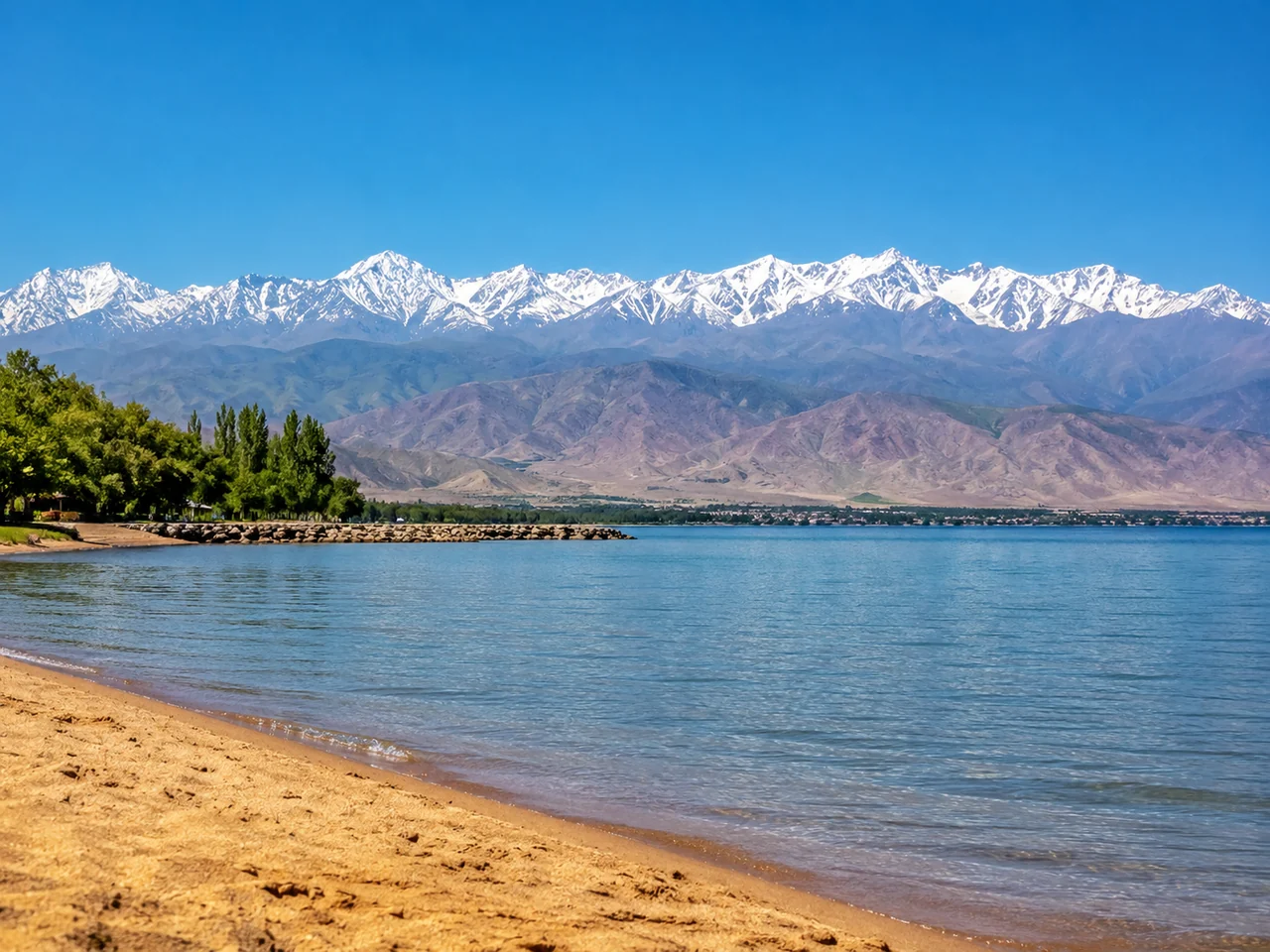
Issyk-Kul is a high-altitude lake in Kyrgyzstan, 260–320 km from Almaty. The drive takes 4–6 hours including border crossing. The swimming season is June–September, with water temperatures up to +24 °C. The northern shore has developed infrastructure, while the southern shore offers wild beaches and tranquility. Prices: guesthouse from 5000 KZT/night, lunch from 1500 KZT. No foreign passport required.
Issyk-Kul: what kind of place is it and how is it different from other resorts
Lake Issyk-Kul is the main resort area of Kyrgyzstan and the closest sea for residents of Almaty, where mountain climate combines with warm water and a long swimming season.
Where is Issyk-Kul located and why do people come here from Almaty
Issyk-Kul is a high-altitude lake in Kyrgyzstan at an elevation of 1607 m above sea level, with an area of 6236 sq. km and a maximum depth of 702 m. From Almaty to the lake is 260–320 km depending on the chosen shore: to the northern shore via Kegen and the Torugart Pass — about 260 km, to the southern shore via Balykchy — 320 km through the Boom Gorge. The drive takes 4–5 hours by car, and 5–7 hours by bus, including crossing the border at "Korday" or "Ak-Tilek". The water is fresh, clear, without jellyfish or algae — swimming is possible from mid-June to the end of September. Due to the altitude, the water warms up to +24 °C, while the air remains comfortable even at the peak of heat — this is the main difference from stuffy southern resorts.
How Issyk-Kul differs from Kapchagay and Alakol
Unlike Kapchagay (water up to +28 °C, flat climate, shallow water) and Alakol (windy, salty water, short season), Issyk-Kul is a freshwater lake with mountain air, a swimming season from June to September, and water temperatures of +20…+24 °C in July–August. At Kapchagay, the water warms up faster, but by August it blooms and becomes murky, while at Alakol, due to constant wind, waves stir up sand from the bottom. At Issyk-Kul, the water remains clear all summer — visibility reaches 5–8 meters near the southern shore. There is no oppressive heat here — the average air temperature in July is +25…+30 °C, making trips comfortable for families with children and elderly people.
When to go to Issyk-Kul: weather by month and swimming season
The swimming season at Issyk-Kul is shorter than at southern seas, but it is stable and predictable — let's break it down by month to see when water and air provide maximum comfort.
Water and air temperature by month
| Month | Water, °C | Air, °C | Season | Features |
|---|---|---|---|---|
| June | +16…+18 | +20…+25 | Start | Few vacationers, invigorating water |
| July | +20…+24 | +25…+30 | Peak | Warmest days, many tourists |
| August | +20…+24 | +25…+30 | Peak | Maximum comfort for swimming |
| September | +18…+20 | +20…+25 | Indian summer | Few people, warm water, tranquility |
When is the best time to go to Issyk-Kul for different purposes
For beach activities with children, July and August are optimal — water is consistently +20…+24 °C, air +25…+30 °C, and the shallow bays of the southern shore warm up by another couple of degrees. For excursions and solitude, choose June or September: there are far fewer tourists, accommodation prices are 20–30% lower, and hiking through gorges and to waterfalls is comfortable without thirty-degree heat. May and October are the time for health resorts with balneological programs: swimming in the lake is no longer possible (water +12…+15 °C), but the mountain air, thermal springs, and empty beaches offer a completely different, relaxed trip format. Seasonal changes here are sharp — at the end of September, after the first cold snap, the water can cool from +20 to +15 °C in a week, so it's better to plan the Indian summer season for the first half of September.
How to get from Almaty to Issyk-Kul: car, taxi, tour
Let's break down all the ways to get to Issyk-Kul — by your own car, taxi, bus, or as part of a tour. We'll consider border nuances, travel time, and the cost of each option.
By your own car: route, border, time
The distance from Almaty to Issyk-Kul is 260–320 km depending on the shore, travel time is 4–6 hours including border crossing. The main route is through the "Korday" checkpoint (Almaty — Bishkek highway, 95 km to the border), an alternative is "Ak-Tilek" in southern Bishkek, which is less crowded but adds 30–40 minutes to the journey. To the northern shore (Cholpon-Ata, Bosteri) from the border, it's another 150 km on a good asphalt road along the lake; to the southern shore (Karakol) — 200 km through a pass with spiral serpentines, where the average speed drops to 40–50 km/h. The road to the southern shore is more scenic but requires driving experience on mountain sections — especially on the descent to Karakol. During peak season (July–August), the queue at "Korday" can reach 1–2 hours — leave at 5–6 AM to cross the border before the rush of cars.
Documents for crossing the Kazakhstan — Kyrgyzstan border
For a trip to Issyk-Kul, a foreign passport is not required — a general civil ID card (for adults) and a birth certificate (for children under 16) are sufficient. By car, you will need the vehicle registration certificate, driver's license, and a "green card" — motor third-party liability insurance valid in Kyrgyzstan; without it, you will be fined 1000–2000 KZT at the border and still be forced to buy a policy on the spot for 4000–6000 KZT. Owners of cars with Kazakhstani license plates should also have a power of attorney if the car is not registered in your name — border guards sometimes check it. The "green card" can be obtained right at the border in 10–15 minutes, but it's better to buy it in advance from an insurance company — it's cheaper and faster, costing about 3000–5000 KZT for 10–14 days.
Taxi, bus, and tour: what to choose
A taxi to Issyk-Kul costs 15,000–25,000 tenge one way, a bus (Almaty — Cholpon-Ata, departures from Sayakhat bus station) — 3,000–5,000 tenge per person, but runs once a day and doesn't always reach guesthouses. Commercial minibuses (marshrutkas) from Sayran bus station are cheaper — 2,000–3,500 tenge, but go to Balykchy, from where it's another 50–100 km to the resorts by hitchhiking or taxi for 3,000–5,000 tenge. A tour from toor includes transfer, accommodation, excursions, and a guide's accompaniment — the price is fixed, with no extra charges for excess luggage or waiting at the border. Unlike a taxi, where the driver may ask for extra payment for downtime in the queue at "Kordai" (another 3,000–5,000 tenge), the tour operator includes all costs in the price in advance — you know the exact trip budget before departure.
South or North Shore: Which to Choose for Your Vacation
The main question before the trip is which shore to choose. The north shore is for comfort and entertainment, the south shore is for peace and wild nature. Let's compare by key parameters.
North Shore: Infrastructure, Villages, Pros and Cons
The north shore of Issyk-Kul is a developed tourist area with the villages of Cholpon-Ata, Bosteri, Kosh-Kol, and dozens of boarding houses, cafes, water parks, and nightclubs. The beaches here are sandy and fine-pebbled, equipped with sunbeds and canopies, the water warms up faster due to the shallows — swimming is comfortable from mid-June. In Cholpon-Ata, there is a water park, amusement park, equestrian theater, and souvenir stalls, while in Bosteri, there are discos and restaurants with live music. The main drawback of the north shore is the noise and crowds during peak season: in July-August, the beaches are packed, and accommodation prices soar by 1.5-2 times. If you're going for peace and seclusion, choose the south shore — there are far fewer tourists, and the water is noticeably cleaner.
South Shore: Wild Beaches, Peace, Features
The south shore of Issyk-Kul features wild pebble beaches with crystal-clear water, minimal infrastructure, and the villages of Karakol, Jeti-Oguz, Barskoon, and Tamga. The beaches here are mostly large-pebbled, with a sharp entry into the water — depth starts a meter from the shore, but the water is transparent, with visibility up to 5-6 meters, ideal for snorkeling and photos. Along the south shore, there are no noisy clubs or water parks, but there are natural attractions: Skazka Canyon with its bizarre rocks, Barskoon Waterfall, and Jeti-Oguz hot springs. The south shore is less suitable for a trip with children — due to the sharp entry into the water and the lack of equipped beaches with a gentle slope. If traveling with toddlers, choose the north shore with its sandy beaches and children's entertainment.
Shore Comparison: Table for Choosing
| Parameter | North Shore | South Shore |
|---|---|---|
| Beach Type | Sand, fine pebbles | Large pebbles, boulders |
| Infrastructure | Developed: cafes, shops, rentals | Minimal: a few cafes, shops in villages |
| Water Entry | Gentle, convenient for children | Sharp, depth starts close |
| Water Clarity | Average (murky near shore) | High (transparent) |
| Entertainment | Water parks, clubs, excursions | Nature, trekking, horse riding |
| Noise | Crowded, noisy | Quiet, secluded |
| For Whom | Families with children, partygoers | Couples, eco-tourists, photographers |
Many tourists mistakenly choose the south shore for beach time, then face a lack of infrastructure — keep this in mind when planning.
Beaches of Issyk-Kul: Sand, Pebbles, Infrastructure
Let's break down the beaches of Issyk-Kul — where there's sand, where there are pebbles, how much sunbeds cost, and if there are free options. This will help you choose a swimming spot for your budget.
Sandy Beaches of the North Shore
Sandy beaches on Issyk-Kul are located on the north shore — in Cholpon-Ata, Bosteri, and the surrounding areas. The sand is fine, golden, the entry into the water is gentle — ideal for children, the beach strip width reaches 10–30 meters. The main infrastructure is concentrated here: rental points for catamarans, water slides, "bananas," and jet skis, and along the shore stretches a row of cafes and stalls with corn and shashlik. During peak season (July–August), the central beaches of Cholpon-Ata are crowded — a free spot by the water appears by lunchtime when some vacationers go to eat. On the sandy beaches of the north shore, the water near the shore can be murky due to suspended sand — this is normal for Issyk-Kul, transparent water is typical for the pebble beaches of the south shore.
Pebble and Wild Beaches of the South Shore
The pebble beaches of the south shore — from the village of Karakol to the Jeti-Oguz gorge — are distinguished by transparent water and the absence of crowds. The beaches are not equipped: no sunbeds, umbrellas, or cafes — only wild nature and the purest water, visibility in calm weather reaches 5–8 meters. Along the south coast, there are small coves with natural stone slabs convenient for diving — depth starts 1–2 meters from the shore, and the entry is sharp, without a gentle shallows. This is an ideal option for those seeking seclusion, setting up a tent, or coming for a day with a picnic. On the wild beaches of the south shore, be sure to bring mats and umbrellas — there's no shade, the pebbles heat up, and the only alternative is shade from coastal bushes, which are scarce.
Cost of Sunbeds and Free Beaches
Entry to most Issyk-Kul beaches is free — you only pay for equipment rental: sunbeds and umbrellas cost 200–500 KZT per set per day, depending on proximity to the water and the season. On the wild beaches of the southern shore, there is no infrastructure — sunbeds are not provided, so vacationers lay blankets directly on the pebbles or bring their own loungers. On the northern shore, in addition to municipal beaches, paid sections of boarding houses and sanatoriums operate: entry with a sunbed costs 300–800 KZT per person, while many boarding houses have their own equipped beaches with free sunbeds for their guests — check this when booking accommodation to avoid paying twice.
Where to stay on Issyk-Kul: villages, hotels, guesthouses — prices in KZT
Let's break down accommodation options on Issyk-Kul — from budget guesthouses to boarding houses with meals. Prices are in KZT so you can immediately estimate your budget.
Guesthouses: prices, conditions, for whom
A guesthouse on Issyk-Kul costs 5,000–15,000 KZT per night, the price includes a room for 2–4 people, a shared kitchen or dining room, Wi-Fi and parking, but meals are not included. In Cholpon-Ata and Bosteri, most such houses are located 5–10 minutes' walk from the beach, hosts often offer transfer from the highway and discounts for long-term rentals from a week. In Balykchy, prices are lower — from 3,000 KZT, but the infrastructure is minimal: one or two shops and no cafes. Guesthouses are the best option for groups and families who plan to cook themselves or eat at cafes, rather than overpaying for three meals a day at a boarding house.
Boarding houses and hotels: prices, meals, infrastructure
A boarding house on Issyk-Kul costs 10,000–30,000 KZT per night with three meals a day buffet or set menu, the price includes accommodation, beach and sunbed use, and in some — a pool and evening entertainment. On the northern shore, popular boarding houses include "Altyn-Kum" and "Goluboy Issyk-Kul" with children's rooms and enclosed grounds, on the southern shore — small hotels in Karakol with their own baths and tour desk. It's better to book rooms 2–3 weeks before your trip during peak season (July–August), otherwise only guesthouse spots at 12,000–15,000 KZT without meals remain for weekends.
Popular villages for accommodation
- Cholpon-Ata: The center of tourist life on the northern shore — many cafes, a water park, tour desks. Accommodation prices are average and above average, from 10,000 KZT per night.
- Bosteri: A quiet village near Cholpon-Ata with a large selection of guesthouses from 5,000 KZT. Good sandy beach and minimal distance to shops.
- Balykchy: The western shore near the border with Kazakhstan — the lowest prices from 3,000 KZT, but almost no cafes or entertainment. Suitable for transit or budget overnight stays.
- Karakol: The base camp of the southern shore for excursions to gorges and waterfalls. Guesthouses and hotels — 5,000–12,000 KZT, nearby market and bus station.
What to see on Issyk-Kul: gorges, waterfalls, hot springs
Issyk-Kul is not just beaches. Around the lake there are dozens of gorges, waterfalls, hot springs and historical sites. We'll tell you about the main points worth including in your itinerary.
Jety-Oguz Gorge: Red Rocks and excursions
The Jety-Oguz Gorge ("Seven Bulls") is the hallmark of the southern shore with red rocks of bizarre shapes. An excursion from Cholpon-Ata or Karakol costs 5,000–10,000 KZT per person, includes transfer and guide accompaniment. In the gorge, there are seven rock remnants of reddish-brown sandstone, each up to 300–400 meters high — they are named after the number of bulls in the legend. On the territory, there is the "Jety-Oguz" sanatorium with its own thermal spring (+42 °C), entry costs 700–1,000 KZT. The best time to visit is morning before 10:00 AM: no crowds of tourists, soft light for photos, fresh air, and hot springs can be combined with the excursion.
Barskoon Gorge and "Red" Waterfall
The Barskoon Gorge is one of the most picturesque on the southern shore, with the "Red" Waterfall (25 m high) and mountain lakes. Entry to the gorge is free, the drive to the waterfall takes 30–40 minutes from the highway. The waterfall got its name from the reddish tint of the rocks at dusk, and in clear weather a rainbow from the spray is visible. Higher up the gorge are three high-altitude Barskoon lakes — a 6–8 km hiking route with a 400 m elevation gain. For a regular excursion, 2–3 hours is enough, and for trekking to the lakes, allow a full day with snacks and a water supply.
Hot springs and mausoleum
On Issyk-Kul, there are several thermal springs — the most popular are in Jety-Oguz and Ak-Suu. Water temperature +35…+45 °C, bathing costs 500–1,500 KZT per person. In Ak-Suu — open pools with mineral water enriched with hydrogen sulfide and silicon, and in Jety-Oguz — covered baths with temperatures up to +45 °C. The Gumbez Mausoleum (19th century) is located in the Manakylly Gorge — a historical monument of nomadic culture, built from adobe brick with a domed roof. Hot springs operate year-round, but are especially pleasant in the off-season (May, September) — after an excursion you can warm up, and the water is considered therapeutic for the musculoskeletal system.
Conclusion
We've gathered key takeaways for those planning a trip to Issyk-Kul — briefly about the main points: choice of shore, budget, timing, transport, and what not to miss.
Key takeaways
- Choose the shore based on your scenario: the northern shore — for beach holidays and nightlife, the southern shore — for seclusion and gorge excursions.
- Plan your budget in advance: an economy trip for 3 days will cost 50,000–70,000 tenge per person, a comfortable tour — from 100,000 tenge.
- Travel in season: July–August — for swimming, May–June and September — for excursions and walks without crowds on the beaches.
- Get there by car: 8–10 hours from Almaty across the border, with extra time for crossing the checkpoint during peak dates.
- Don't limit yourself to the lake: the Jety-Oguz and Barskoon gorges, the Ak-Suu hot springs — a must-do program to make your trip memorable.