Blog
Katon-Karagay: Complete Guide from Almaty — How to Get There, What to See, and Costs in 2026
Katon-Karagay is the largest national park in Kazakhstan (643,477 hectares) in Eastern Kazakhstan, 1100 km from Almaty. Key highlights: Rakhmanov Springs (+37..+42°C), maral farms with antler baths, Mount Belukha, and Lake Yazevoye. The best time to visit is summer or golden autumn, with a toor tour starting from 120,000 KZT per person including transfer and accommodation.
What is Katon-Karagay and why is it interesting
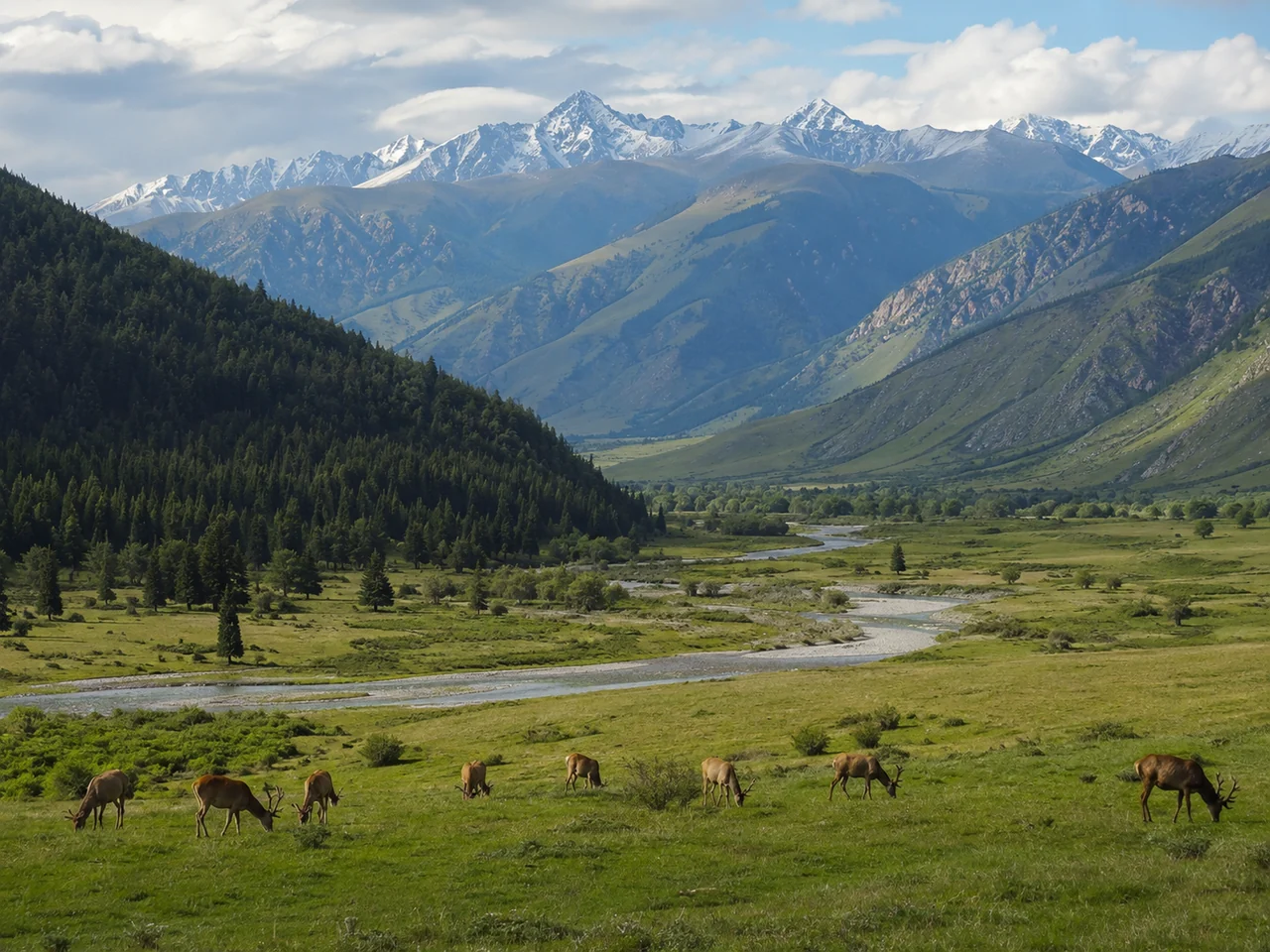
Katon-Karagay is the largest national park in Kazakhstan, located in the East Kazakhstan Region near the border with Russia and China. People come here for alpine meadows, coniferous forests, hot springs, and views of Mount Belukha, the highest peak of the Altai Mountains.
Katon-Karagay National Park: location and scale
Katon-Karagay National Natural Park is the largest in Kazakhstan, covering an area of 643,477 hectares, with elevations ranging from 800 to 2000 meters above sea level. The park encompasses the southern slopes of the Katun Ridge and part of the Sarymsakty Ridge, where the Bukhtarma and Belaya Berel rivers originate. The territory includes three natural-climatic zones: the steppe belt at the foothills, the coniferous forest zone (fir, cedar, spruce), and alpine meadows with mountain lakes above 1800 m. For comparison, the park is almost three times the size of Luxembourg, encompassing alpine meadows, coniferous forests, and high-altitude lakes.
Why people come here: main reasons
People come here for three unique things: the thermal Rakhmanov Springs (+37..+42°C year-round), antler baths at maral farms, and views of Mount Belukha (4506 m), the highest peak of the Altai Mountains. Additionally, here lies the deepest lake in Eastern Kazakhstan, Yazevoye (depth 47 m), and ancient petroglyphs are preserved in the Kyzyltas tract. Unlike many mountain resorts, the routes here are easy to moderate, suitable for families with children, and no special training is required.
When to go: weather by month and seasons
Katon-Karagay has three distinct tourist seasons: summer, golden autumn, and winter. Each has its own weather, activities, and clothing requirements.
Summer (June–August): main season
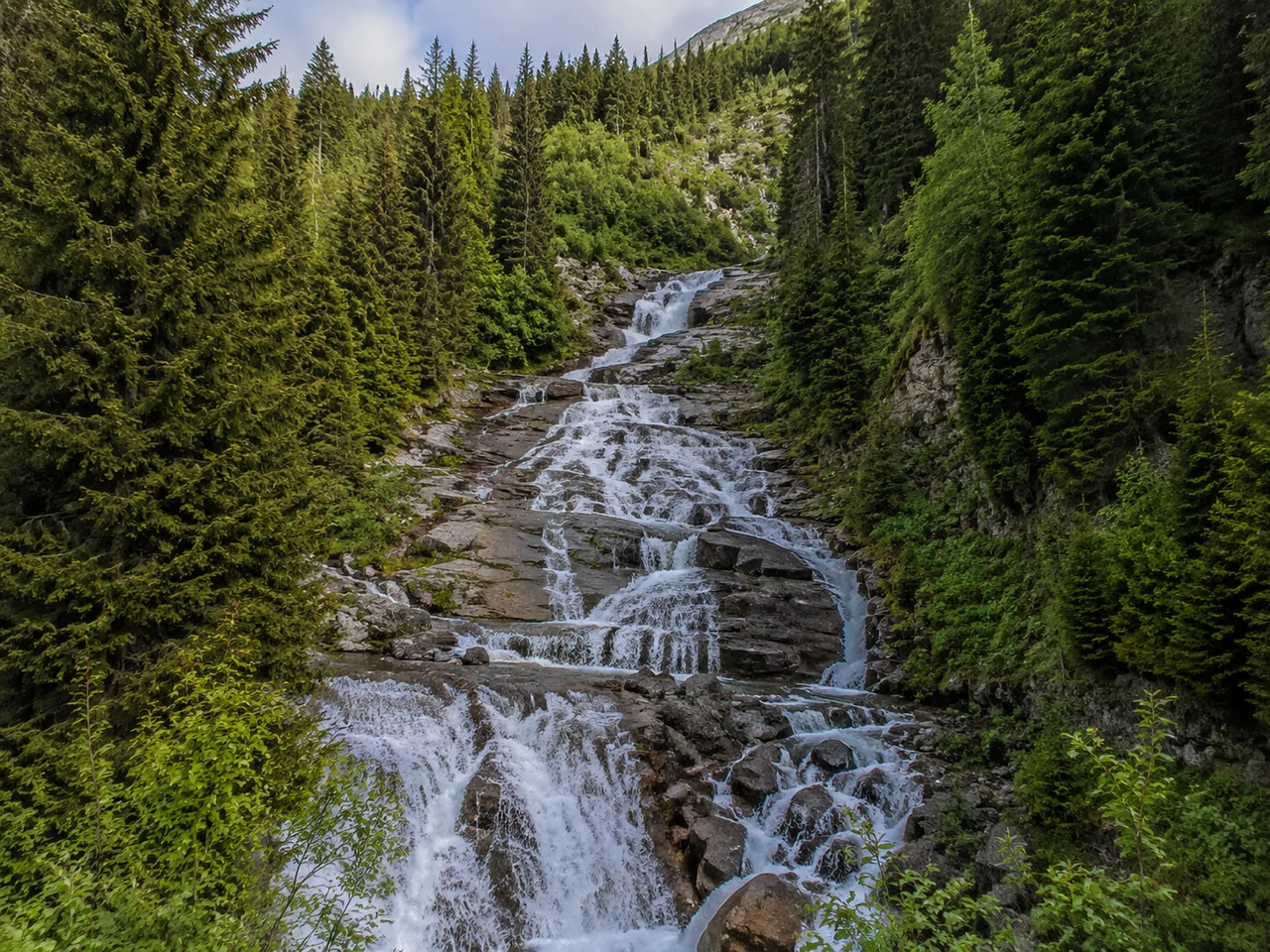
In summer, the area sees +15..+25°C, with July being the warmest month (+18..+25°C), but May–June often bring precipitation, so it's best to plan a trip for July–August. During this time, all trekking routes are accessible, from a radial hike to Kokkol Waterfall to a multi-day traverse of the Sarymsakty Ridge with overnight stays at Lake Yazevoye, where the antler bath season begins at the Altai maral farms in late August (a 15-20 minute procedure at +38..+42°C). Water in mountain rivers warms up to +14..+16°C, and swimming is possible at Bely Plyos, though the main beach days are at Lake Yazevoye with its sandy spits. Even in July, evening temperatures drop to +8..+10°C, so a warm jacket in the backpack is essential, though you can walk in a T-shirt during the day.
Golden autumn (September–October) and winter (December–March)
September–October is golden autumn with temperatures of +5..+15°C, ideal for photos and trekking without summer heat; winter (December–March) is -15..-5°C, suitable for lovers of snowy landscapes and baths. In September, larch trees on the slopes of the Bukhtarma turn yellow, creating a contrast with the emerald river water, with the best shots taken at sunset from the viewpoint near the Chingistay cordon. Snow cover in December reaches 40-60 cm, roads to Rakhmanov Springs are cleared with a grader, but a passenger car without chains won't get through, so locals transport tourists in UAZ vehicles with differential locks. In January-February, frosts down to -25°C occur 3-5 days per month, but on other days it's -10..-15°C with bright sun, perfect for skiing on frozen Lake Yazevoye. In September, the water in Rakhmanov Springs remains at +37..+42°C, comfortable for swimming, and there are far fewer tourists than in July.
Season calendar: what to do each month
| Month | Temperature | Precipitation | What to do | What to bring |
|---|---|---|---|---|
| May | +10..+18°C | Frequent rain | Trekking, springs | Raincoat, warm jacket |
| June | +15..+22°C | Frequent rain | Trekking, fishing | Insect repellent, raincoat |
| July | +18..+25°C | Moderate | All routes, swimming | Swimsuit, warm jacket for evening |
| August | +15..+23°C | Moderate | All routes, antler baths | Swimsuit, comfortable shoes |
| September | +10..+15°C | Little | Photos, trekking, springs | Warm jacket, thermal underwear |
| October | +5..+10°C | Little | Photos, springs, maral farms | Warm jacket, hat |
| December–March | -15..-5°C | Snow | Landscapes, baths | Down jacket, thermal underwear, waterproof shoes |
May and June are the rainiest months, with roads washing out, so for a trip during this time, it's better to choose a tour with transfer on a prepared bus, as local carriers in Toyota Hilux vehicles handle mud where a passenger car would bottom out.
How to get there from Almaty: car, taxi, tour
From Almaty to Katon-Karagay is 1100 km, 14–16 hours of travel. There are three options: by your own car, by taxi, or with a tour. Let's break down the pros, cons, and real numbers.
By car: route, time, costs
The route by car: Almaty → Ust-Kamenogorsk (highway, ~900 km) → Katon-Karagay (another 200 km), total time is 14–16 hours of pure driving, not counting stops. The highway to Ust-Kamenogorsk is good quality asphalt, but on the section from the regional center to the park, there are narrowings and potholes, though four-wheel drive is not needed, and a sedan can manage. Fuel consumption: approximately 80–90 liters round trip (at an average of 9 L/100 km), which at a price of 220–240 KZT per liter gives 18,000–22,000 KZT one way, and for two people round trip, about 50,000 KZT on fuel. It's better to leave early in the morning to avoid driving in the dark, as there is no lighting after Ust-Kamenogorsk and potholes are hard to see at speed.
By taxi: price and features
A taxi from Almaty to Katon-Karagay costs from 80,000 KZT one way, travel time is the same 14–16 hours, but the driver takes you without stops for sightseeing. It's better to book through apps with fixed prices — Yandex Go or inDrive; private drivers ask for 100,000–120,000 KZT during the season. Keep in mind that a taxi is just the ride: accommodation, meals, and entrance tickets are paid separately; the total cost for a trip for two can exceed 200,000 KZT — comparable to a tour, but without an organised itinerary.
With a tour: what's included in the price
A tour to Katon-Karagay costs from 120,000 KZT per person and includes transfer from Almaty in a comfortable minibus with air conditioning, accommodation in guesthouses or hotels in the village, three meals a day with local cuisine, and services of local guides — no extra payments along the way. Departure is early in the morning, with stops for lunch and restrooms on the road; you can sleep on the bus, relieving the fatigue of the long journey. The price is fixed per person, with no surprises like "paying the guide on the spot" — the tour operator organises the itinerary themselves, rather than reselling other people's tours.
Comparison of methods: car vs taxi vs tour
| Parameter | By car | Taxi | Tour |
|---|---|---|---|
| Cost (per person) | ~25,000 KZT (fuel) | from 80,000 KZT | from 120,000 KZT |
| Travel time | 14–16 h | 14–16 h | 14–16 h (with stops) |
| Accommodation | not included | not included | included |
| Meals | not included | not included | included |
| Guide / itinerary | self-guided | none | local guides |
| Travel fatigue | high | medium | low (sleep on the bus) |
When travelling together, a tour is comparable to a taxi plus accommodation, but eliminates the headache of organising the itinerary and meals — driving yourself after 14 hours behind the wheel is risky.
Routes and highlights: what to see in 3–5 days
In 3–5 days you can cover the main attractions: Rakhmanov Springs, maral farms, Lake Yazevoye, and the panorama of Belukha. Here's a ready-made itinerary with daily timing.
Day 1: Arrival, Katon-Karagay village, and acclimatisation
The first day is the road from Almaty (14–16 hours) and settling into the village, which has shops, hotels, and cafes — everything to rest after the journey. The village is the administrative centre of the national park, with two grocery stores, a guesthouse with 10 rooms, and a canteen serving home-style food (average check — 1,500 KZT for dinner). The altitude above sea level ranges from 800 m in the valley to 2000 m on the outskirts — an unaccustomed body reacts with drowsiness and mild shortness of breath. Don't plan activities on the day of arrival: it's better to take a walk along the main street (Lenina, 500 m on foot), have dinner, and go to bed early — tomorrow is a busy day with elevation changes.
Day 2: Rakhmanov Springs and Lake Yazevoye
The second day is a trip to Rakhmanov Springs (+37..+42°C, swimming year-round) and Lake Yazevoye (fishing for grayling and lenok, entrance 500 KZT), the distance between the points is about 30 km. The road from the village to the springs is 40 km of gravel, passable for any car with a ground clearance of 160 mm, travel time is 1–1.5 hours depending on the weather. At Lake Yazevoye, there are two wooden piers for fishing; you can fish without a license, but the catch is limited to 5 kg per person. At Rakhmanov Springs, there are equipped bathing areas, but it's better to bring your own towel and flip-flops — they are not provided on-site, and you can't buy them anywhere except in the village 40 km away.
Day 3: Maral farms, antler baths, and the panorama of Belukha
The third day — maral farms with antler baths (from 5,000 KZT per procedure) and a viewing platform with a view of Mount Belukha (4506 m) — climbing requires experience, but you can admire it from the park. The most famous maral farm is "Altai-Maral" 15 km from the village, which houses 200 spotted deer; the procedure lasts 20 minutes in a wooden barrel with a decoction of antlers, after which rest for 30–40 minutes is recommended. The viewing platform for Belukha is at the "Beryozovka" cordon (entrance 300 KZT); from there, on a clear day, you can see the double-peaked summit — the highest point in the Altai. Antler baths are best taken in a course of 7–10 days (from 70,000 KZT per course), but even one procedure gives a noticeable effect — muscle relaxation and improved sleep for the next two days.
Days 4–5: Trekking in the national park and additional routes
On days 4–5 — trekking along the national park's routes of easy and moderate difficulty: suitable for families with children, no special training required, entrance to the park is 500 KZT per person. The most popular route is "To Belukha" (8 km one way, 3–4 hours of walking) — it goes along the Belya Berel River through a cedar forest with an elevation change of 300 m; there are two gazebos for rest on the trail. The second option is a radial hike to the "Kok-Kol" waterfall (4 km, 1.5 hours) with a 12-meter cascade, accessible for children from 7 years old. The routes are marked, but without a guide it's easy to miss a turn — in the mountains, mobile signal (Beeline, Kcell) only works in the village, so it's better to go with a local guide.
Rakhmanov Springs: temperature, benefits, schedule
Rakhmanov Springs are the main natural attraction of the park. Hydrogen sulfide springs with a constant temperature operate year-round, and it's worth understanding their schedule before the trip.
Water temperature and chemical composition
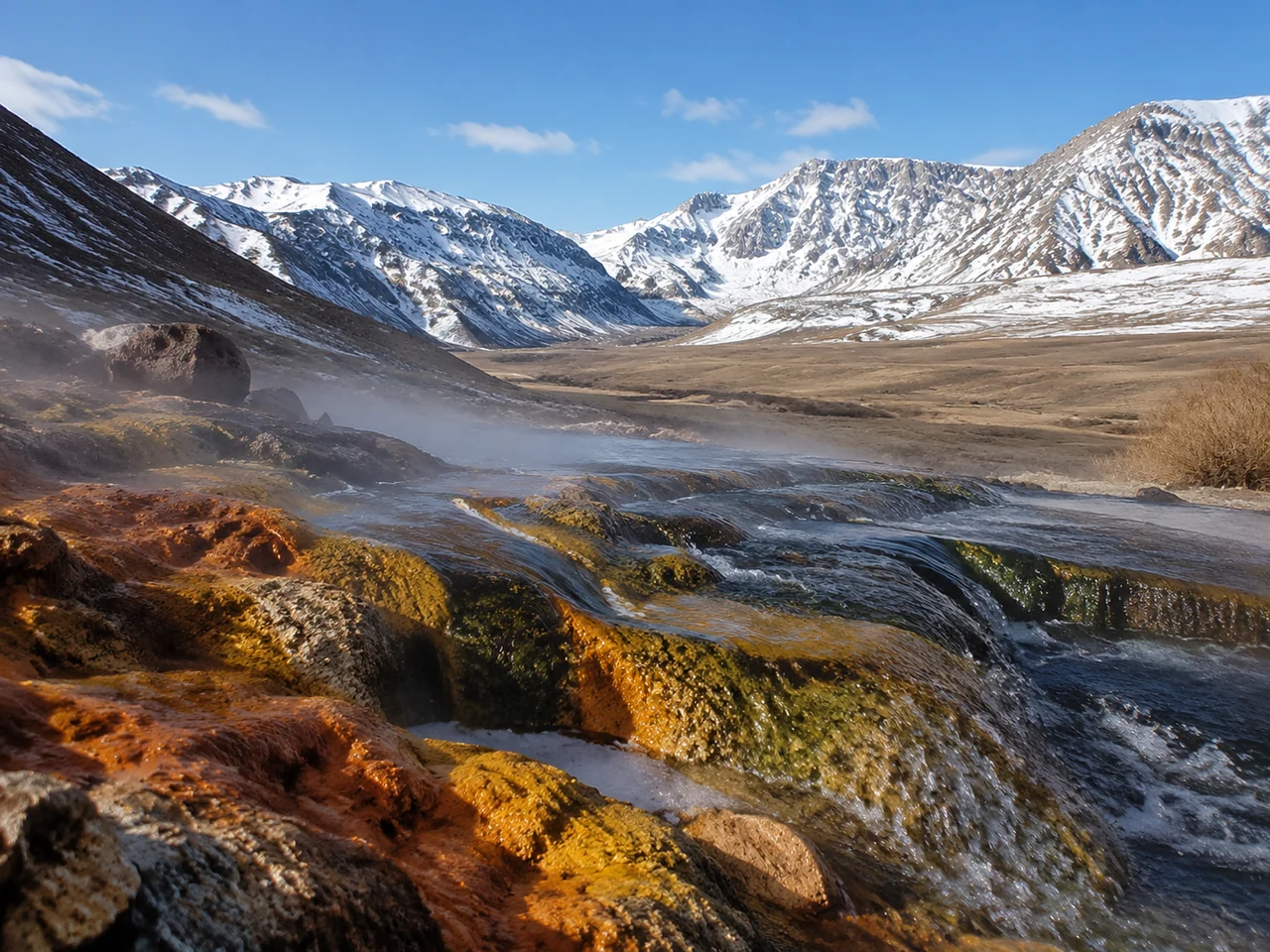
The water temperature at Rakhmanov Springs is constant year-round — +37…+42°C, these are hydrogen sulfide springs with a mineral composition beneficial for joints and skin. The water contains sulfates, bicarbonates, calcium, and magnesium — this combination provides an anti-inflammatory effect for arthritis and dermatitis. The springs emerge from a fault at an altitude of 1600 meters, and the water rises from a depth of about 800 meters, without cooling on the surface. Unlike many thermal springs, the water here doesn't smell strongly of sulfur — the smell is mild, you get used to it in a couple of minutes, and after swimming, the skin becomes smooth, without stickiness, like after brine.
Bathing Regimen and Practical Tips
You can bathe in the Rakhmanov Springs year-round; the optimal time is 15–20 minutes, after which you need 30–40 minutes of rest; a course of procedures is 7–10 days for a therapeutic effect. The outdoor temperature in January can drop to -20°C, but the water is +38°C — the contrast boosts blood circulation, so after bathing, put on a warm jacket and hat immediately without lingering on the shore. Locals advise not to visit the springs on an empty stomach — a light snack an hour before the procedure reduces the risk of nausea from hydrogen sulfide. Do not dive in headfirst — hydrogen sulfide fumes can cause dizziness; it's better to enter gradually and sit waist-deep, especially the first time.
Excursion to the Springs: Price and What's Included
An excursion to the Rakhmanov Springs costs from 3,000 KZT per person; in a toor tour, it's included in the total price — no separate payment is needed. The price includes entry to the national park (500 KZT) and a guide's accompaniment, who will show you where the open pools and closed changing cabins are located. If you're going independently, keep in mind that the road to the springs is a dirt road, washed out after rains; a passenger car may not get through, and you'll have to walk 3–4 kilometers.
Maral Farms: Antler Baths and Health Improvement
Maral farms are facilities where marals (red deer) are raised for their antlers — young horns used to make healing baths. In Katon-Karagai, there are several such farms, each offering its own format of procedures.
What Are Antler Baths and How Do They Work
Antler baths are a procedure where an extract from young maral antlers is added to the water; the price is from 5,000 KZT per immersion, and a full course (7–10 days) is from 70,000 KZT. At the "Altai Maral" and "Berkut" farms, fresh-cut antlers are used — the horns are sawed, filled with hot water, and steeped for 15–20 minutes, after which the tourist immerses in a warm (38–40°C) bath for 10–15 minutes. Biologically active substances — amino acids, collagen, phosphorus, and zinc — penetrate the skin, stimulating tissue regeneration, relieving inflammation, and strengthening blood vessels. The effect is not immediate but appears after 3–4 procedures: improved sleep, reduced joint pain, and increased vigor — locals come for a course every year.
Who Antler Baths Are Suitable For and Contraindications
Such baths are recommended for musculoskeletal disorders (arthrosis, osteochondrosis), nervous exhaustion, and reduced immunity, but are contraindicated for cancer, hypertension (above 160/100), and pregnancy at any stage. During the first procedure, some may experience mild dizziness — this is a normal reaction to active vasodilation, which subsides 10–15 minutes after the bath. Farms offer a preliminary consultation with a paramedic before starting the course, but a full examination is not conducted there. It's better to consult a doctor before the course — the procedure actively stimulates blood circulation and may be harmful for certain chronic diseases.
Where to Stay: Accommodation from Budget to Comfort
In the village of Katon-Karagai and its surroundings, there are several accommodation options: from budget guesthouses to hotels with amenities.
Accommodation Options: Prices and Conditions
A guesthouse costs from 5,000 KZT per night per person, a hotel from 10,000 KZT per night per person; in an organized tour, accommodation is usually included in the tour price. Guesthouses have a shared kitchen, shower, and toilet in the yard or on the floor; bed linen is either your own or for an extra 500 KZT. Hotels have private rooms with a bathroom, TV, and Wi-Fi, often with three meals a day in the dining room. There are also separate cottages — from 15,000 KZT per night for a family, with a private kitchen and veranda. During the high season (July–August), vacancies may be unavailable if not booked 2–3 weeks in advance — especially in guesthouses with good reviews.
What to Consider When Choosing Accommodation
When choosing accommodation, check for heating (even in summer, nights are cold — down to +5°C), hot water, and Wi-Fi: guesthouses may have issues with these, while hotels usually have everything. With children, it's better to choose a hotel with private rooms and a kitchen — guesthouses often have shared facilities and are noisy due to neighbors on the floor, while a separate cottage from 15,000 KZT solves the privacy issue if the budget allows.
Price Guide in KZT for 2026: Entry, Accommodation, Excursions
We've compiled current prices for 2026: park entry, accommodation, excursions, antler baths, and transfer — so you can calculate your trip budget in advance.
Prices for Key Services
| Service | Price (KZT) | Note |
|---|---|---|
| National park entry | 500 per person | One-time |
| Guesthouse (per night) | from 5,000 | Without meals |
| Hotel (per night) | from 10,000 | With amenities |
| Excursion to Rakhmanov Springs | from 3,000 per person | Group |
| Antler bath (1 procedure) | from 5,000 | |
| Course of antler baths (7–10 days) | from 70,000 | |
| Taxi from Almaty (one way) | from 80,000 |
How Much Money to Bring for the Trip
For 5 days, one person without a tour needs from 80,000 KZT: this includes a taxi transfer (if shared with fellow travelers), a night in a guesthouse, meals at local canteens, and a couple of excursions. The main unpredictable expense is the taxi from Almaty: if you can't find travel companions, the price for one way reaches 80,000–100,000 KZT. We recommend budgeting an additional 15,000–20,000 KZT for souvenirs, tips for the guide, and extra procedures at the maral farm — on-site, you'll always want to try more than planned.
Conclusion
We've highlighted five practical takeaways to help you plan a trip to Katon-Karagai without unnecessary hassle or unexpected expenses.
Key Takeaways for a Trip to Katon-Karagai
- Best time to travel — July–August: warm weather, all routes are open, water in mountain lakes is heated to a comfortable temperature, and rains are short-lived.
- Transfer is the main expense: a taxi from Almaty costs from 80,000 KZT one way, so it's more profitable to travel in a group with a rented minibus or choose a tour with included transfer — the price difference per person reaches 40%.
- Book accommodation 2–3 weeks in advance: during the season, good guesthouses and hotels are booked up within a week, especially on weekends — check availability on Booking.com and OLX in advance.
- Be sure to bring warm clothes and a raincoat: even in July, the temperature drops to +5°C at night, and downpours in the mountains start suddenly — without a waterproof jacket, you risk freezing on an evening walk.
- Antler baths are a must-try, but book in advance: a course of 7–10 procedures (from 70,000 KZT) provides a noticeable health benefit, and for July–August, spots at maral farms are sold out a month ahead.