Blog
Karakol Ski Resort: Complete Guide from Almaty — Trails, Prices, Transfer and Hacks 2026
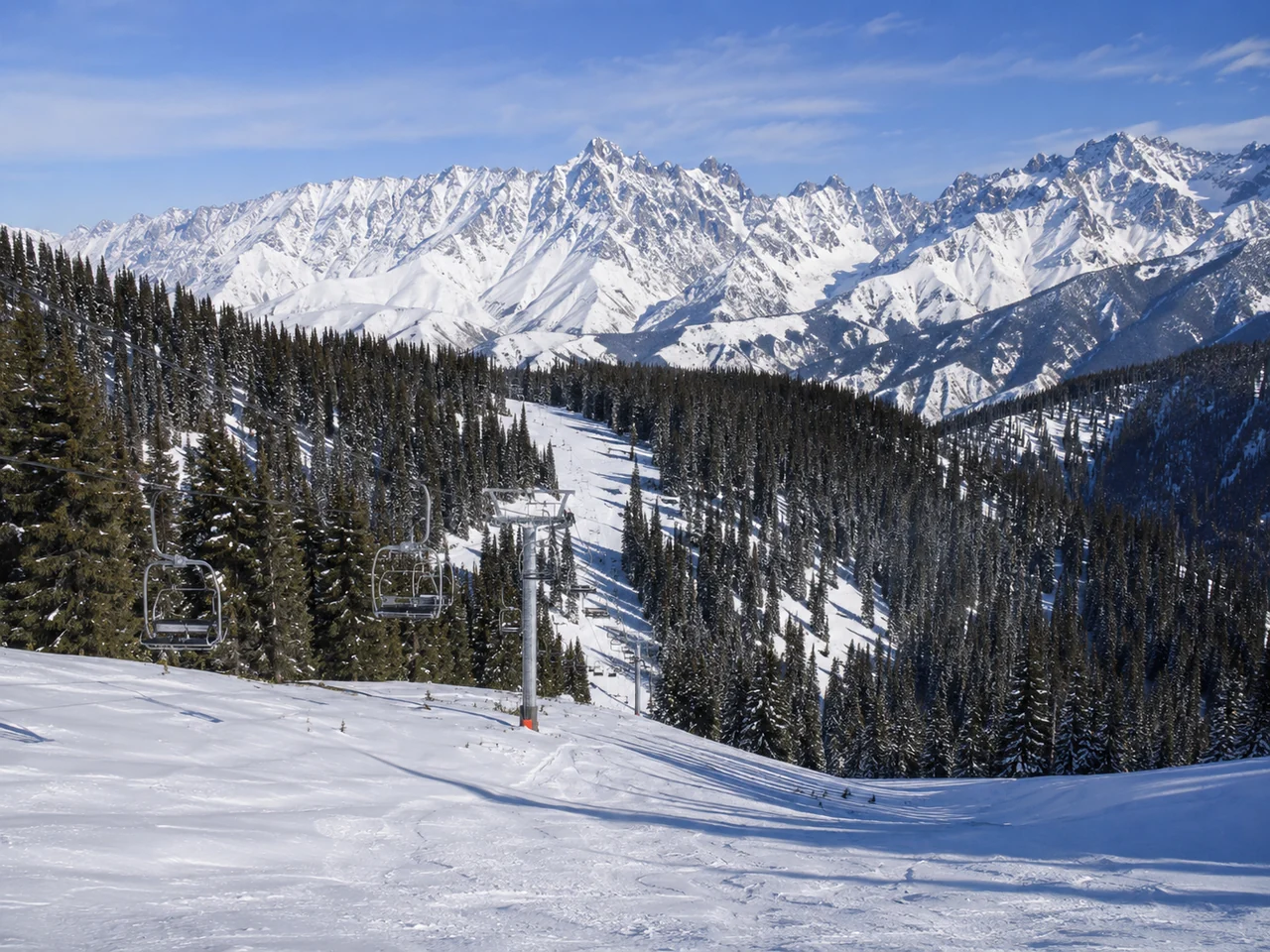
Karakol ski resort in Kyrgyzstan is the main ski destination for tourists from Almaty. 20 trails of varying difficulty, a vertical drop of 740 m, and a ski pass from 1500 KZT/day. The distance from Almaty is 400 km (5–6 hours by car). toor organizes direct tours with transfer, accommodation, and a guide — without intermediaries or hidden fees.
Karakol Ski Resort: Resort Overview
Karakol ski resort in Kyrgyzstan is one of the most affordable options for skiing from Almaty: altitude 2300–3040 m, 20 trails, and a budget 2–3 times lower than Chimbulak.
Where is Karakol Ski Resort Located and Its Altitude
The resort is located 12 km from the city of the same name, at an altitude of 2300 m above sea level, with the top lift point at 3040 m. The base sits on the southern slope of the Terskey-Alatau ridge — this protects it from northern winds and ensures stable snow cover from November to April. The vertical drop of 740 m is one of the largest in Central Asia, providing long and varied descents without frequent lift transfers. For comparison, Chimbulak has a drop of 920 m, but it uses gondola lifts that ascend faster. From the bottom station to the top point on the chairlift takes about 25 minutes — during this time, you can enjoy the panorama of Lake Issyk-Kul in clear weather. When planning your trip, note that the road from Almaty to the base takes 8–9 hours — it's best to leave before dawn to catch the first run by 9 a.m.
How Many Trails and Lifts at Karakol
The resort has 20 trails with a total length of 20 km, the longest being 3.5 km. There are 6 lifts: 4 surface lifts and 2 chairlifts. Chairlifts are rare for Kyrgyzstan resorts and significantly reduce wait times on peak days. Trails are divided by difficulty: 30% green and blue for beginners, 40% red for confident skiers, and 30% black for experts. Surface lifts on the lower section often stop due to cable icing — bring spare gloves and a windproof mask.
How Karakol Differs from Chimbulak
This resort is noticeably cheaper than Chimbulak: a day ski pass from 1500 KZT vs. 8000–10000 KZT, accommodation from 3000 KZT/night vs. 15000–25000 KZT. However, Karakol lags behind Chimbulak in infrastructure — there are no modern gondola lifts or 4–5 star hotels, but for budget week-long skiing from Almaty, it's the best choice. The trails here are longer and less crowded — on weekdays, there are 50–100 people on the slopes vs. 500–800 at Chimbulak. On the other hand, Karakol has almost no evening services: after 6 p.m., only 2–3 cafes and one ski rental shop are open. If you're used to après-ski at Chimbulak with restaurants and spas, be prepared for Spartan conditions — bring a thermos and snacks for the evening.
How to Get There from Almaty: Car, Taxi, Tour with Transfer
Let's break down three ways to get to Karakol from Almaty: by your own car, taxi, or with a tour. We'll compare by price, time, and convenience.
By Your Own Car: Route, Border, Costs
The distance from Almaty to Karakol is 400 km, travel time 5–6 hours including border crossing at the "Korday" or "Karkyra" checkpoints. The route via Korday is 40 km longer, but the road is in better condition — highway M-39 to Bishkek, then a turn to Karakol. The Karkyra checkpoint is half an hour shorter, but the last 30 km is a serpentine road that gets snowed in during winter. Fuel consumption for the entire trip is about 35–40 liters, at a price of 82–85 KZT per liter of AI-95, that's 5000–7000 KZT one way. At the border, you need to pay for car insurance — 1500 KZT, and fill out a migration card for the driver and passengers. In winter, on the Choktal pass, winter tires and tire chains are mandatory — without them, you may be denied entry on the Kyrgyz side.
Taxi from Almaty to Karakol: Prices and Nuances
A taxi from Almaty to Karakol costs from 40000 KZT per car one way, travel time is the same 5–6 hours. The price is fixed but depends on the car class: a regular sedan — 40000–45000 KZT, a minivan for 6–7 people — 55000–65000 KZT. It's better to book through local chats or services like "Poputka Karakol" — there, drivers know the route and border. The issue is that finding a taxi back from Karakol is harder: drivers rarely travel empty, and the price can be 30–40% higher. It's better to order a car with Kyrgyz license plates — this way, you won't have to pay for entry into Kyrgyzstan or go through additional checks.
Tour with Transfer from toor: What's Included and Cost
toor organizes group transfer from Almaty to Karakol on a comfortable bus from 15000 KZT/person — with guide accompaniment and border assistance. The cost includes travel on a Toyota Hiace or Hyundai Starex minibus — 12 seats, air conditioning, reclining seats, charging outlets. The guide meets the group in Almaty, helps cross the border via the "green corridor" — tourists don't wait in the general queue at the checkpoint. Return transfer is included in the tour package: departure from Karakol on the last skiing day at 4 p.m., arrival in Almaty by 9–10 p.m. For solo travelers and couples, this option is 2–3 times cheaper than a taxi, and the guide handles all issues at the checkpoint — the group travels warm without worrying about winter tires and chains.
Comparison of Transfer Options: Price, Time, Comfort
| Option | Price | Travel Time | Comfort | Additional |
|---|---|---|---|---|
| Your own car | Fuel ~5000–7000 KZT | 5–6 hours | Depends on car | Need winter tires, chains, insurance |
| Taxi | from 40000 KZT per car | 5–6 hours | High | One way only, return separately |
| toor transfer | from 15000 KZT/person | 5–6 hours | High (bus, guide) | Includes accompaniment, border assistance |
For a group of 4, a taxi might be more profitable than a tour, but for solo travelers and couples, group transfer is 2–3 times cheaper.
Karakol Trails and Lifts: For Beginners and Pros
We'll tell you which slopes at the resort suit different skill levels — from beginners to experts — and how the local lifts work.
Slope difficulty distribution: green, blue, red, black
Of the resort's 20 slopes, 30% are green (for beginners), 40% are blue (intermediate), and 30% are red and black (for experienced skiers). Green routes are located in the lower part of the resort (2300–2600 m), where the gradient is gentle and the snow cover is denser due to less wind. Blue slopes of medium length — from 1.5 to 2.5 km — wind in serpentines along the slope, allowing you to gain speed on straight sections. Red and black slopes are located above 2700 m, with a vertical drop of up to 400 m and sections with steepness up to 40 degrees — they are regularly groomed by snowcats, but after lunch, moguls appear on them. Green slopes are in the lower part of the resort (2300–2600 m), where the snow is denser and the wind is weaker — ideal for the first days of skiing.
Which slopes suit a beginner and are there instructors
For beginners, the resort has 6 green slopes with a gentle gradient, and instructor services cost 5000–8000 KZT/hour — toor helps organize training. Green routes start from the lower station of the chairlift and run parallel to the surface lifts, so as not to interfere with more experienced skiers descending from above. The instructors at the base are mostly local, from the village of Karakol, many have certificates from the Kazakh or Kyrgyz ski federations — they teach turning and snowplow braking techniques in 2-3 sessions. At the base rental shop, you can rent children's skis and snowboards from 2000 KZT/day, and for kids under 5, there is a tubing slope near the parking lot. Most instructors at the base speak Russian, but during peak season (January–February), it's better to book them in advance through a tour operator.
Lifts: types, speed, queues
The resort has 6 lifts: 4 surface lifts (tow lifts) and 2 chairlifts. The chairlifts serve the upper part of the resort (2600–3040 m). The surface lifts are shorter — they ascend 150–300 m vertically in 5–8 minutes, making it convenient to access green and blue slopes. The chairlifts, both two-seater and three-seater, operate without stops on weekdays, but on weekends from 10:00 AM to 1:00 PM, queues of up to 10 minutes accumulate — the peak time for tourists arriving from Almaty. The lower station is equipped with turnstiles that read ski passes, and the upper station is an open area with a view of Lake Issyk-Kul in clear weather. On weekends, queues for the surface lifts can reach 15–20 minutes, so experienced skiers try to ski on weekdays.
Freeride and off-piste skiing at the resort
The resort is known for off-piste skiing — the snow cover of 1–2 meters allows safe skiing outside the slopes, but only with a local guide. The main freeride zones are located beyond the ridge from the upper station of the chairlift — these are gentle couloirs with up to 50 cm of fresh powder, which are not treated with avalanche cannons. toor includes guide accompaniment in the tour, who knows avalanche-prone areas and will show the best powder descents inaccessible to regular tourists. On the southern slope, closer to the pass, there are rocky outcrops — without knowledge of the terrain, it's easy to damage edges or get injured. For freeriding, it's mandatory to have an avalanche transceiver (beacon), shovel, and probe — these are not available for rent at the base, so bring your own or get them through a tour operator.
Ski pass and prices 2026: how much does skiing cost
Let's break down the ski pass prices in tenge, pass options, and the total budget for a week-long trip — so you can plan expenses in advance.
Ski pass for one day and for 5 days: prices in tenge
A daily ski pass at Karakol costs 1500 KZT on weekdays and 2000 KZT on weekends. A 5-day pass costs 7000–9000 KZT depending on the season — the difference covers peak dates in January-February when the base has the most tourists. The daily ticket gives access to all 6 lifts and 20 slopes, including the chairlift lines to the upper station at 3040 m. Children under 12 get a 30% discount from the adult rate, and pensioners get 20%. Buying a 5-day ski pass is more profitable than a 3-day one: the savings are about 20% compared to daily tickets — for a week-long trip, immediately take the 5-day pass, which locks in the price and eliminates queues at the ticket office.
Full budget for a week-long trip to Karakol from Almaty
| Expense item | Independently (KZT) | In a toor tour (KZT) |
|---|---|---|
| Transfer (round trip) | 15000–40000 | from 15000 (included) |
| Accommodation (6 nights) | 18000–30000 | from 18000 (included) |
| Ski pass (5 days) | 7000–9000 | from 7000 (included) |
| Equipment rental (6 days) | 12000–24000 | 12000–24000 |
| Meals (7 days) | 10500–21000 | 10500–21000 |
| Total | 62500–124000 | from 62500 |
How to save on ski passes and accommodation
The main way to save is to book a tour with transfer and accommodation from us: the group discount on the ski pass and accommodation reduces the total budget by 15–20% compared to organizing independently. The second option is to come on weekdays, when a daily ski pass costs 1500 KZT instead of 2000, and the hotel at the base is cheaper by 500–1000 KZT per night. The third is to stay not at the base, but in guesthouses in the village of Karakol (3000 KZT/night) and rent equipment for a week at once with a 10–15% discount. Independent booking of accommodation through Booking or Airbnb often costs more than through a tour operator due to commissions and dynamic pricing — during peak season, the difference reaches 25–30%.
Ski season and weather by month: when to go
Let's break down when the season opens at Karakol, what the weather is like in different months, and what time is best to go for comfortable skiing.
Ski season at Karakol: December – March
The ski season at Karakol lasts from December to March, peaking in January–February when the snow cover reaches 1–2 meters. In December, there is still little snow — 30–50 cm, only the lower slopes (green and some blue runs up to 2600 m) are open, lifts are lightly loaded, and there are no queues. By the end of December, closer to the New Year holidays, most red runs open, but the upper zone (above 2800 m) may be closed due to unstable snow cover. In January and February, the base operates at full capacity: all 20 runs, both chairlifts and four surface lifts, with stable snow cover of 1–2 meters even on the lower sections. In March, due to daytime thaws, the snow becomes heavy by midday, especially on southern slopes, so it is better to ski from morning until 1:00 PM when the slopes are still firm.
Weather by month: temperature, snow, wind
| Month | Daytime temperature | Nighttime temperature | Snow cover | Wind |
|---|---|---|---|---|
| December | -5..-10°C | down to -20°C | 30–50 cm | Moderate |
| January | -10..-15°C | down to -25°C | 1–1.5 m | Strong at the top |
| February | -10..-15°C | down to -25°C | 1.5–2 m | Strong at the top |
| March | -5..-10°C | down to -15°C | 1–1.5 m | Moderate |
In January and February, on the upper slopes (above 2800 m), the wind can reach 15–20 m/s, reducing visibility and feeling like -25°C — on such days, it is worth bringing a windproof mask and balaclava.
When is the best time to go: recommendations by month
The best time for a trip to Karakol is mid-January and February: maximum snow cover, stable weather, and all runs open. During this period, both chairlift lines operate up to the top point of 3040 m, the snow remains firm until evening, and the chance of rain or freezing rain is minimal. For beginners, January is optimal — the green and blue runs on the lower tier (2300–2600 m) are less affected by wind, with temperatures 3–5°C higher than at the top. In March, it is worth skiing only in the first half of the day: by midday, the snow softens, slushy patches appear on red runs, and icy spots on black runs. We form groups every week during the season, but for peak dates (New Year holidays, February weekends), it is better to book spots 2–3 weeks in advance.
Where to stay: accommodation at the base and in the town
Let's compare accommodation options at Karakol: a hotel right by the lifts, guesthouses in the village, and what to choose for different budgets and travel styles.
Hotel at the ski base: prices and amenities
The hotel at the base costs from 5000 KZT/night, rooms are simple but with heating and hot water, and it is a 2–5 minute walk to the lifts. The building has a shared kitchen with a stove and refrigerator, as well as a canteen where you can order hot meals from 1500 KZT. Rooms are double and triple, with shared showers and toilets on the floor — standard for Soviet-era ski bases. Downsides: noisy in the evenings (tourists gather in the lobby), and Wi-Fi only works at the reception area. In my opinion, for those who came to ski for 3–5 days and value every minute on the slope, this option is optimal — you don't waste time on travel. The hotel has a shared kitchen and canteen, allowing you to cook yourself and save up to 30% on food compared to cafes at the base.
Guesthouses in the village: budget option
Guesthouses in the village (12 km from the base) cost from 3000 KZT/night, but you will need transport to the lifts — a taxi costs about 500 KZT one way. The village has 24-hour shops, a pharmacy, and a central market, where food prices are 1.5–2 times lower than at the base. Guesthouses usually offer rooms for 2–4 people with a private kitchen and shower; many hosts, for an additional fee (1000–1500 KZT), are willing to take and pick up guests from the slope. Downside: to make it to the lift opening (at 9:00 AM), you need to leave the village no later than 8:15 AM. The village has shops, pharmacies, and a market where you can buy food cheaper than at the base, making this option advantageous for longer trips.
What to choose: base or town — comparison
For maximum comfort and time savings, choose the hotel at the base; for a budget trip, choose guesthouses in the village. If you are going as a group for a week, the difference in accommodation cost will be 14,000–20,000 KZT, but you will add 6,000–10,000 KZT for taxis over the same period. For families with children, I recommend the hotel at the base — no need to drag a child out into the cold at 8 AM. For those planning to ski for 2–3 days and not wanting to worry about logistics, through us you can book a tour with accommodation right at the base — this eliminates the need to find transport to the lifts and daily taxi expenses.
Equipment rental and instruction with an instructor
We'll tell you where to get equipment at Karakol, how much it costs, and how to arrange instruction with an instructor.
Ski and snowboard rental: prices and range
Equipment rental at Karakol costs 2000–4000 KZT/day for a set (skis/board + boots), a helmet — an additional 500–1000 KZT. The rental point operates right by the lifts, pickup takes 10–15 minutes, queues only occur during peak season (January-February) in the first half of the day. The range includes Salomon and Burton boards for beginner to intermediate levels, Atomic and Fischer skis in lengths from 150 to 180 cm, and boots in most sizes from 36 to 47. The rental equipment is basic; for advanced riders, it is better to bring your own skis or board — the selection of carving and freeride models is limited.
Instructor at Karakol: prices and how to book
Instructor services cost 5000–8000 KZT per hour; we help book a Russian-speaking instructor in advance to avoid waiting in line. The base employs about 15 instructors, most of whom speak Russian, but during high season, spots may not be available on-site — booking 2–3 days before the trip is mandatory. Lessons are held on equipped training slopes near the lower station of the chairlift, a safe area without crossing main trails. It's best to take a first lesson with an instructor for 2 hours — during this time, a beginner learns the basic stance and braking, after which they can ski on green trails independently.
Conclusion
A trip to the Karakol ski base from Almaty is a budget-friendly option for Kazakhstanis, combining quality trails and the absence of visa formalities.
Key takeaways for the trip to the resort
- Logistics: Getting to Karakol from Almaty takes 6–8 hours by bus from 5000 KZT or taxi from 25,000 KZT, and direct transfers eliminate the hassle of finding a car.
- Budget: A week-long trip costs 200,000–300,000 KZT per person, including transfer, ski pass, accommodation, meals, and equipment rental.
- Trails: 12 trails from green for beginners to black for experts, plus a freeride zone and heli-skiing.
- Documents: Kazakhstanis only need a foreign passport — registration for up to 30 days is processed automatically at the border.
- Gear: Bring thermal underwear, a mask, a helmet, and sunscreen; rent skis with boots on-site.
What to bring: equipment checklist
We've compiled a full checklist for a trip to Karakol — from thermal underwear to a first aid kit — so you don't forget anything or carry unnecessary items.
Mandatory gear: thermal underwear, mask, protection
- Thermal underwear: essential — cotton under a ski suit gets wet in an hour; synthetic or merino wool wicks moisture and retains heat even at -15°C on upper trails.
- Ski mask: at an altitude of 3000 m, the sun reflects off the snow and burns the retina even in cloudy weather — without a mask, snow blindness sets in within an hour.
- Helmet and back protector: on the resort's red and black trails, there's hard crust and icy patches — a fall without a helmet risks a concussion; a back protector saves the spine during a hard landing.
- Sunscreen SPF50: at altitude, UV is 30% more aggressive than in the city — you can get sunburned in 20 minutes even at subzero temperatures.
- Thermos with hot tea: there are no cafes at the top; a snack on a bench at -10°C without a hot drink quickly leads to hypothermia.
First aid kit and documents: what to definitely bring
For documents, only a foreign passport is mandatory — no visa is needed for citizens of Kazakhstan; registration for up to 30 days is automatically stamped at the border when entering Kyrgyzstan. In the first aid kit, include painkillers (ketoprofen or ibuprofen), plasters for blisters and cuts, motion sickness medication (the road to Karakol is a 400 km serpentine), and frostbite cream like "Spasatel" or "Bepanten" for cheeks and nose in the wind. We remind tourists about documents a week before departure and check the validity of their foreign passport — a common issue is when the passport expires in 2-3 months, and border control may deny entry.
What NOT to bring to Karakol
- Large suitcase: the base has narrow corridors and stairs without an elevator — a soft wheeled bag or a 60-80 liter backpack is much more convenient for transport.
- Your own food: the base has a cafe with hot meals from 1500 KZT and a shop with basic products — there's no point in bringing cans and grains from the city.
- Expensive electronics: hotel rooms and guesthouses don't have safes; leaving a laptop or expensive camera unattended is risky — a phone for photos is enough.
- Ski boots: they can be rented on-site for 2000 KZT/day — cheaper than paying for excess baggage (over 20 kg on a flight to Bishkek costs from 3000 KZT per kg).