Blog
Lake Kaindy from Almaty: How to Get There, What to See, and How Much It Costs in 2025
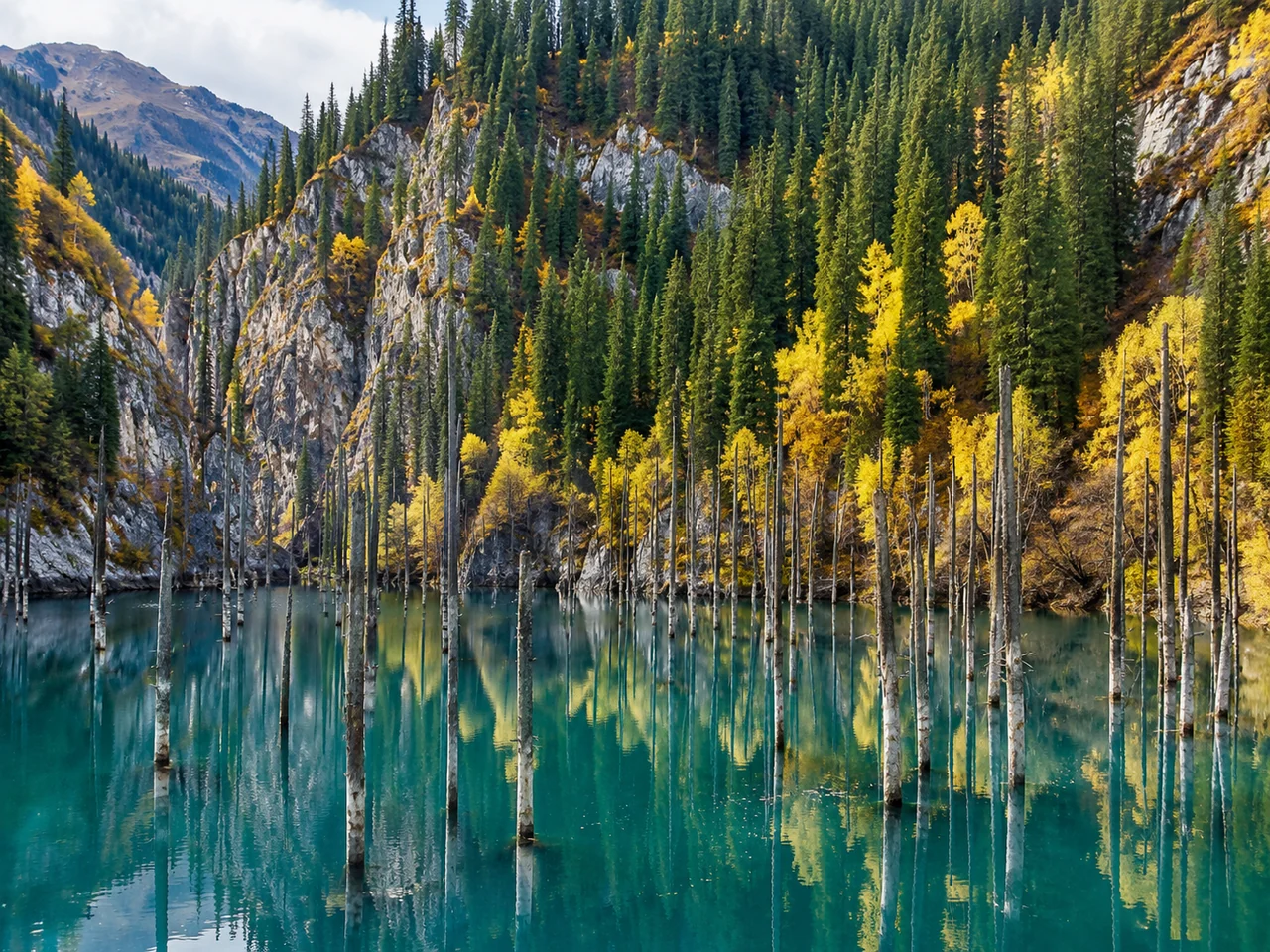
Lake Kaindy is a unique mountain lake 280 km from Almaty with an underwater forest of Schrenk's spruces. You can get there by taxi (25,000–40,000 KZT one way), by your own car (an SUV is needed), or with a toor tour from 15,000 KZT per person with transfer and a guide. The best season is June–September.
What is Lake Kaindy and what makes it unique
Lake Kaindy in the Kungei Alatau is one of the most unusual in Kazakhstan: an artificial reservoir that appeared after an earthquake, with a submerged spruce forest under turquoise water at an altitude of 2000 meters.
How Lake Kaindy formed and why there is an underwater forest
It formed at the beginning of the 20th century after the 1911 earthquake, when a mountain landslide blocked the gorge, and water flooded the spruce forest of Schrenk's spruce that grew here. Over a hundred years, the trunks have been preserved in the cold water — they do not rot and stand vertically, rising from a depth of 5–15 meters almost to the surface. The water in the lake does not warm above 6–8 °C even in summer, which stopped the decomposition of the wood. Because of this, the underwater forest is the only place in Central Asia where you can see an entire submerged forest in its pristine state. In my opinion, it is this picture — trunks disappearing into the turquoise depths — that makes the lake a must-visit, although the road here takes almost the whole day from Almaty.
Key parameters of the lake: depth, size, altitude
It is located at an altitude of 2000 meters above sea level, its length is 400 meters, width is 200 meters, and the maximum depth reaches 30 meters with an average of 15–20 meters. The shoreline is slightly indented, so you can walk around the lake in 1.5–2 hours without special training. Due to the altitude of 2000 m, acclimatization goes unnoticed for most tourists, but with a quick ascent from Almaty (650 m), slight shortness of breath when walking is possible — especially on the approach to the water along a trail with an elevation change of about 100 meters.
Why the water is turquoise and clear
The water has a turquoise hue due to a suspension of limestone particles, and transparency reaches 10–15 meters — the spruce trunks are visible from the surface even without diving. The color changes during the day: in the morning it is deep turquoise, by noon it lightens to bluish due to the reflection of the sun, and after 16:00 it darkens again. The underwater forest is best seen in calm weather from 8:00 to 10:00 am, when the sun is at the right angle and there is no ripple on the water — at this time there are also the fewest tourists on the lake.
When to go to Kaindy: seasons and weather by month
Let's break down when the season opens at the lake, what the weather is like by month, and why swimming is not worth it even in the heat.
Season at Kaindy: from June to September
The tourist season at the lake lasts from June to September, with the peak in July–August, when the daytime air temperature reaches +25…+30°C, and the water warms up to 10–14°C. In June, prolonged rains and cool weather (+15…+20°C) are still possible, and in September after sunset the thermometer drops to +5°C. The road to the lake gets muddy after rains — without an SUV with high ground clearance, it is better not to venture in June and September. During peak season, the shore is crowded, especially on weekends, and the parking lot fills up by 10 am. In my opinion, the ideal window is the second half of August: stable warmth, fewer tourists than in July, and the water is at its warmest. A warm jacket is mandatory in any month — mountain weather changes in half an hour.
Water temperature by month: June, July, August
The water temperature at Kaindy in June is 8–10°C, in July — 10–12°C, in August — 12–14°C, which makes swimming uncomfortable even on the hottest day. The lake is fed by glacial streams from the Kungei Alatau ridge — the water remains cold all year round, and even in August at +14°C, immersion for more than 2–3 minutes can cause hypothermia in an unhardened person. Swimming is not recommended, but many tourists go into the water up to their knees for photos — it is easy to slip on the wet, rocky bottom, so it is better not to risk it without trekking shoes.
When is the best time to come for photos
The best time for photos is morning from 8:00 to 10:00 and evening from 17:00 to 19:00, when the sun illuminates the turquoise water and the underwater trunks become maximally visible. At noon, due to the bright sun, the underwater forest glares and is almost invisible in photos — it is better to come to the lake at opening or stay until sunset. A mirror-like surface without ripples occurs only in calm weather, and in the mountains the wind often picks up after 14:00, so the morning hours give the clearest shot.
How to get from Almaty to Lake Kaindy: all options
Let's break down three main ways to get to Kaindy — by your own car, by taxi, or with an organized tour — with prices, pros, and cons of each option.
By your own car: route and vehicle requirements
The route to the lake from Almaty is 280 km, of which 150 km is asphalt to the village of Saty and 130 km is dirt road to the destination, taking 3.5–4.5 hours depending on the weather. The asphalt part (Almaty — Saty via the Kegen highway) is in good condition, gas stations are near Shelek and Kegen, but after the turn to Saty, a serpentine with steep climbs and gravel surface begins, where the average speed drops to 20–30 km/h. On the dirt road, there are large stones and washouts from meltwater, especially on the section along the Karakungei gorge — here you need a ground clearance of at least 180 mm to avoid damaging the engine oil pan. In a passenger car, you can only drive in dry weather — after rain, the dirt road gets muddy, and a sedan risks getting stuck; the optimal option is an SUV or crossover with high ground clearance.
By taxi from Almaty: prices and features
A taxi to Kaindy costs 25,000–40,000 KZT one way, with the driver waiting for you at the lake for an additional fee (from 500 KZT per hour) or leaving — then you'll have to catch a ride back from tourist groups. It's better to order a car through inDriver or Yandex Go with the "Intercity" tariff — this locks in the price before departure, and drivers from Saty know the road without a navigator, unlike Almaty taxi drivers who often get lost on the dirt road. With local drivers, you can negotiate 30,000–35,000 KZT for a full day with 3–4 hours of waiting and a return transfer — their contacts are available at guesthouses in the village of Saty. If you take a taxi both ways with 3–4 hours of waiting, the total cost can reach 60,000–80,000 KZT — this is 2–3 times more expensive than a group tour, even for one person.
With a toor tour: transfer, guide, and all-inclusive
A group tour toor to Kaindy costs from 15,000 KZT per person and includes round-trip transfer, guide services, entrance tickets to the national park, and an eco-fee — no hidden extras. The bus departs from Astana Square at 6:00–7:00 AM, with a stop in the village of Saty for breakfast and restroom, and at the lake itself, the guide leads a two-hour excursion: showing the submerged forest from four viewpoints, telling the story of the 1911 earthquake, and explaining why the water remains turquoise even in cloudy weather. The cost includes insurance along the route and hot tea with sandwiches in a thermos — a small thing, but at an altitude of 2000 meters without a cafe, it's a lifesaver. For one or two people, the tour is cheaper than a taxi both ways (15,000–30,000 KZT vs 50,000–80,000 KZT), plus you get a guide who will conduct the excursion and show you the best photo spots.
Comparison of options: table
| Parameter | Own car | Taxi | Tour toor |
|---|---|---|---|
| Cost per person | ~5,000–8,000 KZT (fuel) | 25,000–40,000 KZT one way | from 15,000 KZT (all-inclusive) |
| Cost for 2 people | ~5,000–8,000 KZT | 50,000–80,000 KZT round trip | from 30,000 KZT (2 people) |
| Transfer | Self-driven | Available, but expensive | Included round trip |
| Guide | No | No | Yes (Russian-speaking) |
| Entrance tickets | +1,000 KZT per person | +1,000 KZT per person | Included |
| Risk of getting stuck on the road | Yes (especially in a sedan) | No (local driver) | No (professional driver) |
| Departure from Almaty | Any time | By arrangement | 6:00–7:00 AM |
Road to Kaindy: road conditions and what to consider
We'll describe the road from Almaty to Kaindy in detail — where the asphalt is, where the dirt road is, which sections are the most difficult, and how weather affects passability.
Asphalt to Saty: 150 km of comfortable road
The first 150 km from Almaty to the village of Saty is good asphalt along the highway to Narynkol, the journey takes about 2–2.5 hours and is passable in any car. On this section, there are two gas stations — in Uzynagash and Chilik, so it's better to fill up with fuel in advance, especially if you're driving a diesel. The road goes through Kaskelen and Shelek — the asphalt is in good condition throughout, with almost no potholes or bumps. In Saty, it's worth making a stop — there's a store with food and water, as well as a restroom; further on, for 130 km, there will be no infrastructure.
Dirt road from Saty to Kaindy: 130 km of off-road
After Saty, a 130 km dirt road begins, which is passable in a crossover in dry weather, but after rain turns into a clay mush where even SUVs get stuck. The section from the 30th to the 50th km is the most broken — there are deep ruts from trucks, and ground clearance below 180 mm will definitely scrape the bottom. At the 80th km, there's a steep serpentine with narrow turns, where oncoming traffic requires caution. The average speed on the dirt road is 30–40 km/h, so covering the section takes 1.5–2 hours; in rain, the time can increase to 3–4 hours, and the risk of suspension damage in a passenger car is high.
How weather affects the road
In dry weather, the dirt road is passable for any car with ground clearance from 180 mm, but after rain, the road becomes slippery and sticky — only a four-wheel-drive SUV can get through. In spring, during snowmelt, on the section from the 10th to the 20th km, mud puddles up to half a meter deep appear, where even prepared vehicles get stuck. In July-August, with stable heat, the dirt road dries out in 1–2 days, and passability is at its maximum. It's best to plan the trip for the 3rd–5th day after the last rain — by then, the dirt road dries out, and the risk of getting stuck is minimal even in a crossover.
What to see at Kaindy: routes and main spots
We'll tell you what exactly to see at this lake, how long the visit will take, which spots are must-see for photos, and whether there are hiking trails around the reservoir.
Route along the lake: from the viewpoint to the far shore
The main route at Kaindy is a walk along the shore, 400 meters long from the viewpoint at the entrance to the far end of the lake, taking 2–4 hours without diving. The road is dirt, flat, and runs along the water's edge — you can walk it in 15–20 minutes one way, but with stops for photos and observing the underwater forest, you'll stretch the walk to an hour and a half. After rains, the ground becomes slippery, especially on the descent to the water at the viewpoint. At the far shore, the road ends — beyond that, a steep climb into the forest begins, where it's better not to go without a guide. The best view of the underwater forest opens from the middle of the lake — there, the spruce trunks come closest to the surface (5–7 meters) and are clearly visible even without polarized glasses.
Main photo spots at the reservoir
- Viewpoint at the entrance: panorama of the entire lake from above — the best "postcard" shot with turquoise water and mountains in the background.
- Left bank by the water: close-up of underwater trunks — visible spruce trees extending 3–5 meters deep from the surface.
- Far end of the lake: view of the Kungey Alatau mountains framed by trunks — the most "wild" angle without people.
- Wooden pier on the left bank: from here you get the most striking shots with mountain reflections in the turquoise water, especially at sunset.
Are there hiking trails around the lake
Around Kaindy there are no equipped hiking trails — the lake is surrounded by steep, forested slopes, so walking is only possible along the shore on a dirt road. The exception is the trail to Kaindy Waterfall, which starts 2 km from the lake and leads up the gorge, but in the dry season the waterfall dries up, making it pointless to go there. If you want a hike, you can climb the slope above the lake — from there you get a top-down view of the entire bowl with turquoise water, but the ascent requires good physical fitness and comfortable shoes.
Diving at Kaindy: immersion to the underwater forest
Let's break down how much a dive to the submerged forest costs, whether a certificate is needed, and at what time underwater visibility is at its maximum.
Cost of diving and what's included
A dive to the submerged forest costs 25,000–35,000 KZT per session, which includes a full set of equipment — wetsuit, air tanks, mask, fins — and accompaniment by a certified instructor. Time underwater is limited to 20–30 minutes due to low temperatures: the wetsuit protects against cold, but the air supply in the tank at depths of 10–15 meters is used up faster than in shallow water. Some organizers include transfer from the parking lot to the lake (about 1.5 km on foot along the trail) in the price, while others charge an additional 2,000–3,000 KZT for this. A wetsuit is mandatory — water temperature even in August does not exceed 12–14°C, without it the dive will last no more than 5 minutes due to the risk of hypothermia.
Is a certificate needed and what is underwater visibility
No diver certificate is required for the dive — the instructor gives a 15-minute briefing right on the shore, explains pressure equalization techniques and underwater communication signals, then accompanies beginners in pairs. Visibility is 10–15 meters, the water is clear thanks to the limestone composition of the rocks, which filters out suspended particles. At depths of 5–15 meters, dozens of Schrenk spruce trunks stand vertically — some have retained their bark and branches, with small duckweed and lime deposits visible on them. Underwater, you will see vertically standing Schrenk spruce trunks extending 5–15 meters deep — this is a unique spectacle that divers come from all over Kazakhstan to see.
When is the best time to dive
The best time for diving is July and August, when the water warms up to 10–14°C, and visibility is at its maximum due to the absence of prolonged rains, which stir up silty sediment from the bottom and reduce transparency to 3–5 meters. In May and June, the water is colder (6–10°C), and in September the diving season effectively closes — the temperature drops to 4–8°C, and even a wetsuit doesn't prevent rapid heat loss. It's better to dive in the first half of the day (before 12:00) — after noon, the wind stirs up waves, visibility worsens, and the water cools faster.
Combining with Kolsay: how to visit two lakes
We'll explain how to combine a visit to Kaindy and Kolsay in one day — the optimal route, time for each lake, and why it's more cost-effective than two separate trips.
Optimal route: Kaindy → Kolsay in one day
The optimal one-day route: depart from Almaty at 6:00, Kaindy from 9:00 to 12:00 (sightseeing + photos), lunch, then Kolsay from 13:30 to 17:00 (walk along the lower lake), return by 20:00–21:00. It's not worth leaving before six in the morning — the national park gates open at 8:00, and on the Almaty — Kegen highway, traffic is already heavy at that time. Allocate exactly three hours for this lake: the first hour — descent to the water and shooting turquoise hues, the second — a walk along the shore to the central part, the third — ascent to the observation platform above the water. The lakes are 30 km apart on a dirt road — the transfer takes 40–50 minutes, so combining two locations in one day is quite feasible and doesn't require an overnight stay.
What to see at Kolsay
At Kolsay, it's worth walking along the shore of the Lower Lake (Kolsay 1) — there are wooden walkways, observation platforms, and a café, and the water has a bright green hue surrounded by spruce forest. You won't have time to see the Upper Lakes (Kolsay 2 and 3) on a one-day route — they are 5–7 km on foot up the trail, a separate full-day hike. Unlike Kaindy, at Kolsay you can rent a boat (2,000–3,000 KZT/hour) and sail across the lake — this gives a completely different perspective on the mountains and surrounding forest than the view from the shore.
Combined tour toor: Kaindy + Kolsay
toor offers a combined tour "Kaindy + Kolsay" in one day with transfer, guide, and all entrance tickets — price from 20,000 KZT per person. The cost includes travel in a comfortable SUV (the road to Saty is a dirt track, a sedan is a risky option there), accompaniment by a Russian-speaking guide, and eco-fees for both national parks. The route is designed so that you have time for this lake in the morning light (best time for photos) and for Kolsay in the afternoon — without rushing or racing against time.
Where to stay near Kaindy: accommodation options
After a day route through two lakes, it makes sense to stay overnight on site — let's break down three accommodation options: from budget yurts to full-board tours.
Guesthouses near Kolsay
At Kolsay, several guesthouses operate (from 5,000 KZT/night per person) — they offer beds in shared rooms, a shared kitchen with a gas stove, and a bathhouse for an additional fee. The distance to the lake is a 5–10 minute walk, and there is parking for cars and SUVs on the premises. Electricity is available in the houses, with outlets working until 11:00 PM — a power bank will come in handy if you plan to charge multiple gadgets. If you're driving your own car, a guesthouse at Kolsay is more convenient than a yurt at Kaindy — there is parking and light, and in the morning you can be the first to visit the lake before tourist groups arrive.
Yurts at Kaindy
Near the lake, there are yurts (from 3,000 KZT/night) — this is an authentic option with minimal comfort: a sleeping bag, a potbelly stove, and an outdoor toilet. There is no electricity, no mobile signal, and the nearest store is in Saty (22 km away). The yurts have no outlets or connection — bring a power bank and a flashlight, and cook food over a campfire (firewood can be bought on site for 500 KZT). In my opinion, this option is only suitable for those who want complete immersion in the mountain atmosphere and are ready for Spartan conditions.
toor tour with accommodation
toor organizes two-day tours to Kaindy and Kolsay with an overnight stay in a guesthouse — price from 35,000 KZT per person, including transfer, guide, meals, and accommodation. The itinerary is designed so you have time for an evening walk at Kolsay and a morning photo at the lake before the mass influx of tourists. In the two-day tour, you visit both lakes without rushing, and in the evening you have dinner by the campfire and watch the starry sky in the mountains — this is impossible on a one-day trip, but it offers the main advantage: you are not tied to daylight hours.
Conclusion
We have gathered key takeaways to help plan a trip to Lake Kaindy — from logistics to practical tips.
Main takeaways
- The road to Kaindy is 4–5 hours from Almaty: the last 30 km is a dirt road, passable by sedan in dry weather, but requiring caution on the way back in the rain.
- The best time to visit is May–October: when the road is open and there is no snow; peak season is July–August with comfortable weather of +15…+25 °C.
- The trip budget ranges from 15,000 KZT (tour) to 40,000 KZT (taxi): a self-guided trip in your own car will cost 5,000–7,000 KZT for fuel.
- Be sure to bring warm clothes, a raincoat, water, and food: there are no cafes at the lake, and mountain weather changes in 15 minutes.
- The lake and Kolsay can be combined in one day: the distance between them is 30 km, the transfer takes 40–50 minutes, and the combined route gives maximum impressions in one trip.