Blog
Burkhan Bulak Waterfall: How to Get There from Almaty – Complete Guide to the Waterfall in the Dzungarian Alatau
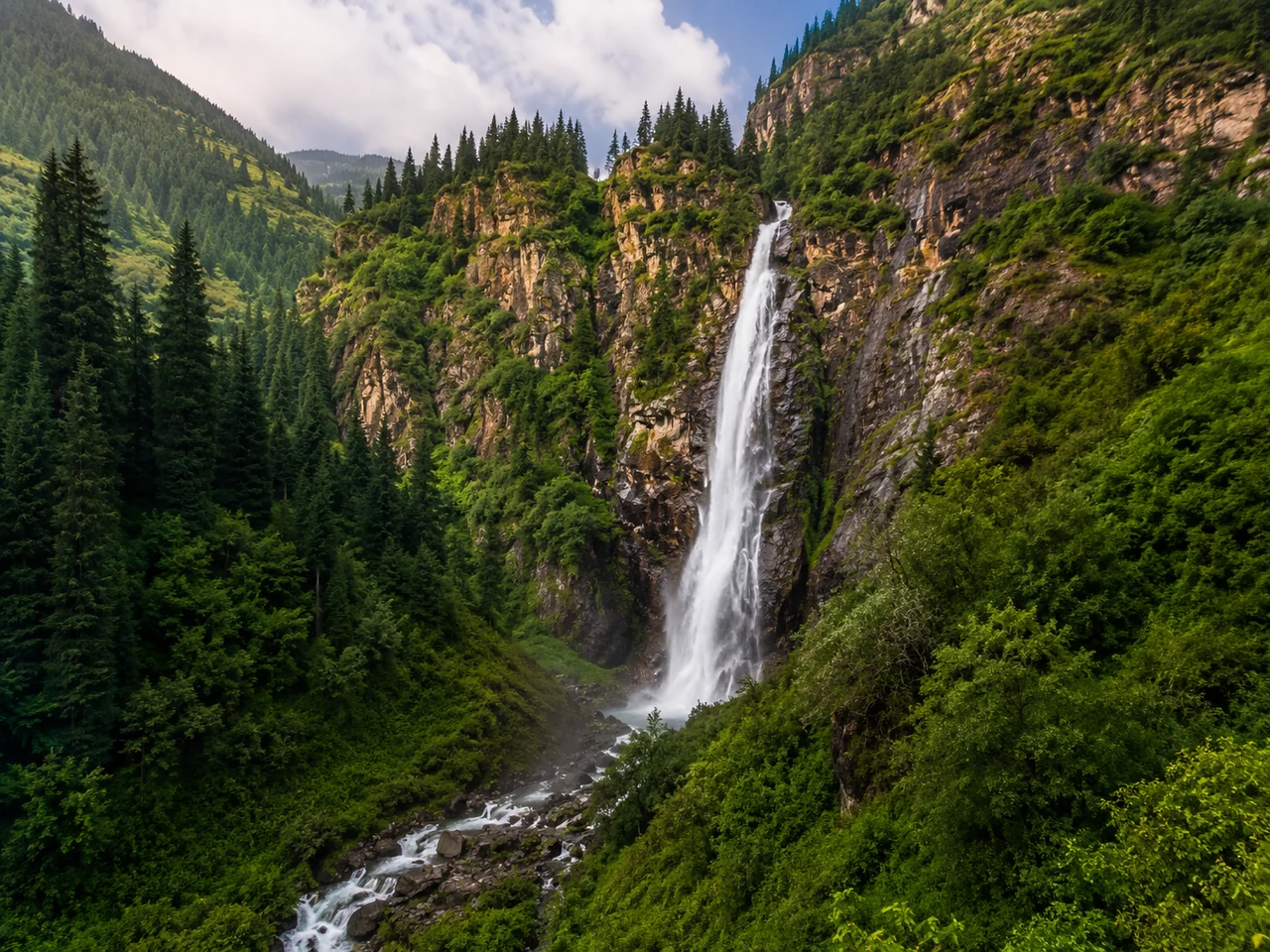
The Burkhan Bulak waterfall is located in the Dzungarian Alatau, 520 km from Almaty. You can get there by car (A-3 highway to Sarkand, then a dirt road — 6–7 hours), by taxi (from 80,000 tenge), or as part of a tour from toor with transfer and a guide (from 35,000 tenge per person). The season is June–September.
What is the Burkhan Bulak waterfall and what makes it unique
We'll tell you what the Burkhan Bulak waterfall is, why it is considered one of the highest in Kazakhstan, and what attracts travelers to it.
Height and cascades of the Burkhan Bulak waterfall
This waterfall is one of the highest in Kazakhstan: its cascades reach 168 meters, and the water falls from a plateau at an altitude of 1800 meters above sea level. Unlike lowland waterfalls, it is fed by meltwater from the glaciers of the Dzungarian Alatau — the maximum water flow occurs in June–July, when the stream peaks, and by September it noticeably weakens. The cascades themselves are not monolithic: the water breaks off from three ledges, forming a powerful stream in the lower part that crashes against the rocks and creates a cloud of fine spray visible from a kilometer away. In the dry season (August–September), the waterfall splits into separate streams, exposing the black basalt slabs that still have a continuous wall of water running over them in May. When planning a trip, it's worth considering this seasonality: for spectacular shots with the full cascade, it's better to go in early summer, and for quiet contemplation and trekking without spray, at the end of August.
Why the waterfall is called the "pearl of the Dzungarian Alatau"
Burkhan Bulak is called the pearl of the Dzungarian Alatau because of its unique combination: a 168-meter cascade surrounded by the Burkhan River canyon, alpine meadows, and glacial lakes. Unlike the popular Turgen Gorge, the road to it passes through a real mountain desert — beyond Sarkand the landscape changes dramatically, and the last 80 km of dirt road give a feeling of complete isolation from civilization. There are no cafes, signs, or asphalt around the waterfall — only wild nature: marmots, golden eagles, and traces of mountain goats are encountered on the approaches. It is this remoteness that creates the magic of the place: the noise of the water here drowns out everything, and in clear weather, rainbows hang over the canyon. Those accustomed to well-equipped tourist bases should be prepared for a complete disconnection from the network and a lack of infrastructure — this is part of the experience.
Where is Burkhan Bulak located: coordinates and altitude
Exact coordinates, altitude above sea level, and distance from major cities — so you can plan your route and not get lost on the approach to the waterfall.
Waterfall coordinates and nearest landmarks
The Burkhan Bulak waterfall is located in the Dzungarian Alatau at coordinates 44°30′N 79°30′E, at an altitude of 1800 meters above sea level, 80 km from the village of Sarkand and 200 km from the city of Taldykorgan. The landmark on the A-3 highway is a turn north near the village of Lepsy, after which a dirt road begins along the Tentek River. The road to the waterfall itself winds through the gorge, crosses three small streams, and leads to a plateau with a view of the canyon. The altitude of 1800 meters is not the highest point of the route, but the mark at which the lower tier of the waterfall is located; the upper cascade rises another 200 meters higher. It is worth entering the coordinates into the navigator in advance — there is no mobile connection for most of the route, and without offline maps, it's easy to miss the turn from the A-3 highway onto the dirt road.
Distance from Almaty to Burkhan Bulak
The distance from Almaty to the Burkhan Bulak waterfall is 520 km, and the travel time by car is 6–7 hours excluding stops. The route passes through Taldykorgan and Sarkand along the A-3 highway, then a turn onto a dirt road about 80 km long. Travelers from the southern capital usually leave at 6–7 am to have time to complete the trek before dark and return to the city by night: daylight hours in the mountains are shorter due to the surrounding ridges. Of these 520 km, about 80 km is a dirt road after Sarkand, which can become difficult for a regular sedan after rains, so it's better to plan the trip in a car with high ground clearance.
When to go: seasons and weather by month
Let's break down which months the road is open, when the waterfall is at its fullest, and what weather awaits you at different times of the year.
Visiting season: from June to September
The visiting season for Burkhan Bulak is from June to September; from October to May the road is closed due to snow, and it is impossible to reach the waterfall even in an SUV. In June and July, when the glaciers of the Dzungarian Alatau melt, the waterfall is at its fullest — the stream peaks, and the roar of the water is heard a kilometer from the canyon. By the end of August, the water flow noticeably decreases, and in September it becomes about half as much as the June level — the cascades become thinner but do not lose their spectacle. At the same time, September offers a unique atmosphere: the birch groves along the trail turn yellow, and the contrast of the golden foliage with the gray rocks of the canyon creates shots unavailable in summer. The highest water period is June and July, when the glaciers of the Dzungarian Alatau melt; in August the flow decreases, and in September the waterfall noticeably diminishes, but the autumn foliage around the canyon gives a completely different atmosphere.
Daytime and nighttime temperatures by month
In July, the daytime temperature at Burkhan Bulak reaches +20°C, and at night it drops to +5°C; in September, it's about +15°C during the day and down to 0°C at night. In June, the weather is most unstable: +15…+18°C during the day, but a sharp wind from the gorge is possible in the afternoon, dropping the temperature to +10°C in half an hour. August is the most comfortable month: consistently +22…+25°C during the day, nighttime temperatures stay at +8…+10°C, and rain is rare and brief. In September, the sun goes behind the ridge crest already at 4:00 PM, and the temperature drops by 10-12 degrees in an hour — by evening, being near the waterfall without a warm jacket is uncomfortable. The temperature difference between day and night is 15–20 degrees, so even in July, a warm jacket and raincoat are mandatory — without them, an overnight stay in a tent or yurt will turn into a trial.
Best time for photos
The best time for photographing Burkhan Bulak is in the morning from 8 to 10 AM, when the sun illuminates the cascades from the front, and in the evening from 5 to 7 PM, when the light becomes soft and golden. In the morning, the rays pass along the canyon, highlighting the waterfall's spray and creating a rainbow in the lower third of the stream — for this, stand on the left bank 20-30 meters from the base. In the evening, the sun sets behind the ridge crest, and the waterfall falls into shadow, but the reflection of the cliffs in the lake at the base creates a mirror effect — this is especially visible in calm weather. At noon, due to the contrast lighting, the waterfall often appears overexposed in photos, and the canyon shadows hide details — plan your shoot for the morning to capture both the waterfall and its reflection in the lake at the base.
How to get there from Almaty: car, taxi, tour
Let's compare three ways to reach the waterfall: by personal car, by taxi, and as part of a tour — with prices, time, and features of each option.
By car: route along highway A-3 and dirt road
By car to Burkhan Bulak, you drive along highway A-3 to Sarkand (440 km of asphalt), then 80 km of dirt road to the plateau; total time — 6–7 hours, it's better not to risk the dirt road in a regular sedan after rains. The asphalt on A-3 is good, but between Taldykorgan and Sarkand there are no gas stations for 240 km — fill up a full tank in the city. After Sarkand, a rocky serpentine begins with a 15–20 degree slope and single-lane width: passing bays occur every 2–3 km, and after a downpour, the dirt road turns into a muddy mess where even four-wheel drive gets stuck. Before leaving, check the forecast — if rain is predicted, postpone the trip to a dry day, otherwise you risk getting stuck overnight without communication.
Taxi from Almaty: price and features
A taxi to Burkhan Bulak costs from 80,000 tenge one way, travel time — 6–7 hours, but drivers rarely agree to drive on the dirt road without extra payment. On aggregators, the price to Sarkand is from 50,000 tenge, and for driving on the dirt road to the plateau, they ask for an additional 20,000–30,000 tenge on top, and not all drivers know the road — the turn to the waterfall is easy to miss without a navigator. Finding a car back on the plateau is impossible: there is no signal, passing tourists are rare, and walking to Sarkand is 80 km. Arrange with the driver for a full-day wait in advance or look for an option with a return transfer — otherwise, after the walk, you'll have to spend the night by the waterfall without a tent.
Tour from toor: what's included and how much it costs
The tour to Burkhan Bulak waterfall from toor costs from 35,000 tenge per person and includes transfer from Almaty, guide services, meals, and insurance — this is a direct tour operator with a fixed price and no extra charges. Departure at 6 AM from Abay Square, group of up to 10 people, stop for breakfast in Taldykorgan and lunch at the base of the waterfall — a thermos with tea and hot sandwiches are included in the program. Guide Aidos Serikov, with 14 years of experience, conducts a briefing, monitors safety on the route, and shows not only the waterfall but also hidden spots — lakes Zhasylkol and the Burkhan River canyon, which are easy to miss without a guide. Unlike private drivers who simply drop you off at the plateau, toor provides full support with a radio and satellite phone in case of emergencies.
Comparison of methods: car, taxi, tour
| Parameter | Personal car | Taxi | Tour from toor |
|---|---|---|---|
| Cost | Fuel ~15,000 tenge | From 80,000 tenge one way | From 35,000 tenge per person |
| Travel time | 6–7 hours | 6–7 hours | 6–7 hours (with stops) |
| Guide | No | No | Yes (experienced guide) |
| Insurance | No | No | Yes |
| Risk of getting stuck | High (dirt road) | Medium (driver may refuse) | Minimal (transfer included) |
| Communication on the route | No | No | Yes (radios, satellite phone) |
Routes and trekking: from the parking to the waterfall
Let's break down step by step the route from the parking lot to the base of the waterfall: how far to walk, what the elevation gain is, what you encounter along the way, and how difficult it is for beginners.
Trekking from the plateau to the waterfall: 2–3 km with 200 m elevation gain
The trekking from the parking lot on the plateau to the base of Burkhan Bulak waterfall is 2–3 km one way with an elevation gain of 200 meters, medium difficulty, travel time — 40–60 minutes. The trail goes along a rocky slope alternating steep climbs and short flat sections; in the first 500 meters, you gain about 80 meters in elevation — this is the most strenuous part. Further on, the trail becomes gentler, but the surface remains the same: scree of fine slate and large boulders that shift underfoot — on the descent, this requires special caution. In dry weather, the route is passable for any person without excess weight or heart problems, but in rain, the stones become slippery, and without trekking boots, the risk of twisting an ankle sharply increases — sneakers with smooth soles are not suitable here, and experienced hikers bring trekking poles.
What you see along the way: canyon, river, and alpine meadows
Along the way to the waterfall, you get a view of the Burkhan River canyon, alpine meadows with wild grasses, and, in clear weather, the snowy peaks of the Dzungarian Alatau on the horizon. About 10–15 minutes into the walk, the trail leaves the open plateau into a shallow gorge, where rock walls 15–20 meters high rise on both sides — in the shade, it's always 5–7 degrees cooler than in the sun, which is noticeable even on a summer afternoon. A bit higher, at an altitude of about 2600 meters, the alpine meadow zone begins: in June — edelweiss and gentian, in July-August — a continuous carpet of red poppies and yellow buttercups. The most photogenic spot is not right at the waterfall, but halfway up the climb, where the trail emerges onto an open ledge: from here, you can see the entire 60-meter cascade and the canyon bend, and in the morning hours (before 10:00 AM), there are almost no people here, and the sun highlights the water spray.
Can you go with children
A trip to Burkhan Bulak with children is possible, but with limitations: the 2–3 km trek with a 200 m elevation gain is suitable for children aged 10–12 with good physical fitness, while younger ones are better off sticking to a walk on the plateau at the base. Children under 10 often get tired within 15–20 minutes on the ascent due to the elevation change and thin air (the plateau is around 2500 meters), and carrying a child back down over the scree is a risky endeavor. The main difficulty for children is not so much the distance, but the temperature swings and lack of civilization: there are no cafes, toilets, or shops on the plateau, and the 6–7 hour drive back from the waterfall to Almaty can tire even an adult, so bring a supply of water and snacks for a full day.
What to see nearby: lakes, canyons, passes
We'll tell you which attractions are worth seeing in the vicinity of the waterfall — lakes, canyons, and passes that are often overlooked.
Lakes Zhasylkol and Baltykkol
5–7 km from the Burkhan Bulak waterfall are the high-mountain lakes Zhasylkol and Baltykkol — turquoise glacial water bodies with clear water and views of snowy peaks. Zhasylkol (from Kazakh: 'green lake') is larger in area, with an emerald hue due to glacial silt; Baltykkol is smaller and located 100 m higher up the slope. Both lakes are fed by meltwater from the Dzungarian Alatau glaciers, so they are fullest in June–July. The road to them is a separate 3–4 hour trek suitable only for prepared tourists; without a guide, it's easy to get lost, as the trail is unmarked and the navigator doesn't pick up a signal in these parts.
Burkhan River Canyon and Kokzhota Pass
The Burkhan River Canyon stretches for several kilometers below the waterfall, and Kokzhota Pass (2800 m) opens a panorama of the entire valley and the neighboring ridges of the Dzungarian Alatau. The canyon walls are composed of red-brown rocks, which look especially impressive at sunset when the sun illuminates the cliffs from below. The Burkhan River itself is a turbulent mountain stream with cascades of small waterfalls and boulders up to 2–3 m in diameter. Kokzhota Pass is one of the most challenging points on the route: the ascent takes about 2 hours, winds at the top can reach 15–20 m/s, and in winter, snow lies here even in June, so it's best not to venture to the pass without a warm windproof jacket.
Where to stay: overnight in yurts and a tent camp
We'll break down the overnight options near the waterfall: from renting a yurt to setting up your own tent — with prices and conditions.
Yurts at the waterfall: price and conditions
On the plateau at the base of Burkhan Bulak, you can rent a yurt for the night — the cost is from 5,000 to 7,000 tenge, with mattresses and blankets inside, but no heating or electricity. It accommodates up to 4–5 people, mattresses are laid out directly on the floor, blankets are woolen, but it's still worth bringing a sleeping bag — at night in the mountain valley, even in late July, the temperature drops to +5°C, and a thin blanket won't keep you warm. Amenities are minimal: an outdoor toilet, water from the stream or Burkhan River, cooking must be done over a campfire or your own gas burner, and firewood can be bought from locals for 500–1000 tenge per bundle. Yurts are not a hotel, but minimal overnight accommodation: if you're not ready for Spartan conditions without a hot shower and electrical outlets, it's better to choose a day trip without an overnight stay.
Tent camp: what you need to know
Setting up tents is allowed on the plateau, but there is no organized campsite with firewood and a toilet — all equipment, including the tent, sleeping bag, gas burner, and water, must be brought with you. Set up your tent on a flat area at the base of the cliffs, away from the stream bed — in June–July, due to glacial melting, the water level can rise by 20–30 cm overnight, and your sleeping bag could end up in a puddle. Firewood can be bought from locals or dry deadwood can be collected in the forest lower down the gorge, but damp wood at an altitude of 1800 meters hardly burns — bring dry fuel or a gas canister with you. At night, even in July, the temperature drops to +5°C, and the wind from the plateau blows through a regular tourist tent — bring a three-season model with good wind protection and a sleeping bag with a comfort rating of at least -5°C, otherwise the overnight stay will turn into a struggle for warmth.
Price guide: entry, transport, accommodation
We'll summarize all trip expenses in one table: entry, transport, accommodation, and food — so you can calculate your budget in advance.
Price table for a trip to Burkhan Bulak
| Expense item | Price (tenge) | Note |
|---|---|---|
| Entry ticket | 500 | Per person |
| Parking | 500 | Per car |
| Yurt for the night | 5,000 – 7,000 | Per person, without heating |
| Taxi from Almaty (one way) | from 80,000 | Without return transfer |
| Tour from toor (per person) | from 35,000 | Includes transfer, guide, meals, insurance |
| Guide services (self-organized) | from 15,000 | Per group, recommended |
| Fuel (Almaty — Burkhan Bulak — Almaty) | ~15,000 | For a passenger car |
How much does a tour from toor with an overnight stay cost
A two-day tour to Burkhan Bulak from us with an overnight stay in tents or yurts costs from 35,000 tenge per person and includes transfer from the city, guide services, meals (dinner, breakfast, and lunch), insurance, and all necessary equipment — tents, sleeping bags, mats. On the route, the guide shows where to get drinking water from a spring at the base of the waterfall and explains why you can't set up a tent closer than 50 meters to the riverbed — at night, the water level rises by 20–30 cm due to glacial melting. Unlike day trips, the two-day format allows you to leisurely explore the surroundings — lakes Zhasylkol and Baltykkol, the canyon, and Kokzhota Pass — without a race against time, and in the evening by the campfire, the guide talks about the local fauna and teaches how to distinguish bear and wolf tracks.
What to bring: gear and clothing
Let's break down what you'll actually need for a hike to the waterfall — from footwear to a first aid kit — so you don't carry too much or end up without essentials on the trail.
What you must bring to Burkhan Bulak
- Hiking boots: essential — sneakers slip on wet rocks at the base of the waterfall and get soaked within the first 500 meters of the trail.
- Warm jacket: even in July, at 1800 m elevation, it's +5°C in the evening, and the wind from Kokzhota Pass makes it feel like 0°C.
- Raincoat: weather in the Dzungarian Alatau changes in 15 minutes — a downpour can hit you on the open section of the Burkhan River canyon.
- Water and snacks: at least 1.5 liters per person plus nuts and chocolate — there are streams, but drinking without boiling is risky due to runoff from pastures, and there are no shops until Sarkand.
- Sunscreen and hat: UV is 30% more intense at altitude — you can get sunburned even on a cloudy day within an hour on the plateau, where there's no shade until the waterfall.
- First aid kit: band-aids, bandage, painkiller, insect repellent — in toor tours, guides provide a group first aid kit, but keep your own medications with you.
What toor provides for free rental
On our tours to Burkhan Bulak, all participants receive a tent, sleeping bag, sleeping pad, gas burner, cookware, and a group first aid kit for free — none of this needs to be brought from home. The three-person tents with a double fly are designed for winds up to 15 m/s, and the sleeping bags with a comfort temperature of +5°C are sufficient for summer overnight stays on the plateau. The gas burner and cookware set allow you to prepare a hot dinner without a campfire, which is critical in the protected area where open fires are prohibited. This is especially convenient for travelers flying to Almaty: there's no need to haul bulky gear in luggage — just a backpack with personal items and season-appropriate clothing.
Conclusion
We've gathered the key things to remember before your trip to Burkhan Bulak Waterfall: from trail accessibility to hidden opportunities in the surrounding area.
Key takeaways
- Accessibility: Burkhan Bulak Waterfall is 200 km from Almaty — you can get there in 3–4 hours by car or with a tour; the road is partly asphalt, partly gravel.
- Seasonality: The best time to visit is from May to September; in the off-season, the road is washed out, and in winter, the waterfall freezes and approaches are dangerous.
- Difficulty: The trek to the waterfall is moderate — suitable for beginners with good physical fitness but requires hiking boots and basic gear.
- Cost savings: A self-guided trip is cheaper only with a full car (4 people); with a tour, you get transfer, guide, meals, and insurance with no hidden costs.
- Surroundings: Near the waterfall are Zhasylkol and Baltykkol lakes, a canyon, and Kokzhota Pass; a two-day tour lets you see everything without rushing.